
Rainbow Yoga articles
But First, CONNECTION!
Why connection comes before content, correction and challenge—with research, coffee humour and practical ways to build belonging in kids yoga classes.
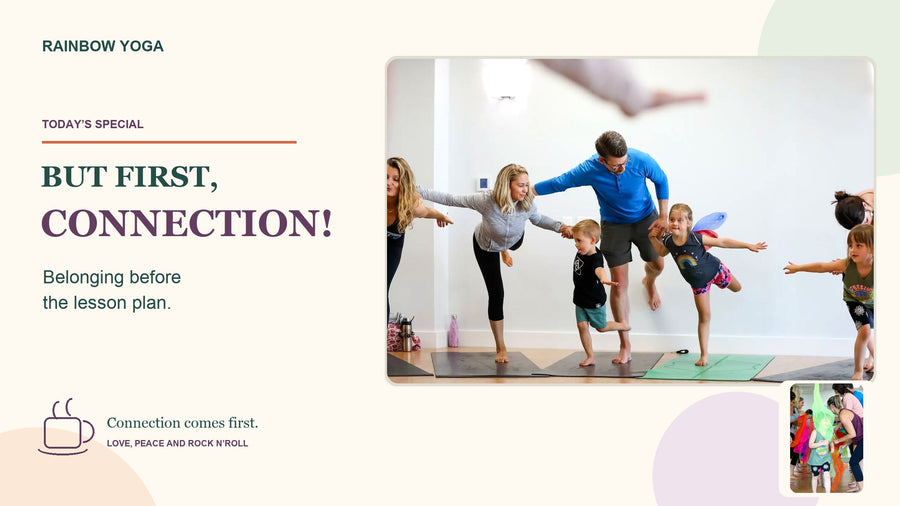
A LITTLE COFFEE HUMOUR. A LOT OF HUMAN CONNECTION.
Connection before content. Connection before correction. Belonging before the lesson plan. What happens when we put the relationship at the heart of teaching?
We have mugs that say “But first, coffee.”
We understand this sentence immediately. Please do not hand me a spreadsheet, a complicated decision or a cheerful account of your entire morning until I have had a moment to become a person.
We lovingly arrange the conditions for our own participation. The right cup. A little pause. Someone remembering how we take it. Perhaps nobody shouting “PAY ATTENTION!” directly into the milk frother.
Then we walk into a room of children and announce twenty-seven things they must do.
Sit down. Listen. Find a partner. Be kind. Be calm. Be confident. Stop being silly. Express yourself, but please make it fit neatly into the next four minutes.
Perhaps our teaching needs a new mug.
But first, CONNECTION!
Children do not need an espresso before Tree Pose. They need opportunities to experience: “Someone sees me. My voice matters. There is a place for me here.”
That is a powerful starting point for education, parenting and kids yoga. A relationship gives the learning somewhere to land.
Connection is an encounter. Belonging is having a place.
Connection can happen in a small exchange. A child tells you about a new puppy. Next week you remember the puppy’s name. A child offers a strange movement. You become curious about it. A child says “no” to holding hands, and the game makes room for that answer.
Belonging grows when those encounters become a reliable experience: I am accepted, included and able to contribute here.
It is possible to be present without feeling that you belong. A name on the register is useful administration. It is not a relationship.
Likewise, a circle of yoga mats is a lovely shape. It can still contain a child who is repeatedly left without a partner, cannot access the game, or feels that everybody else knows the secret rules.
We have to look beyond the arrangement of the furniture and ask about the experience of the people.
RESEARCH TO SIT WITH
Being in the room is not the same as belonging
A recent Monash University analysis of PISA 2025 reported that one in five Australian 15-year-olds felt like an outsider at school, one in four felt awkward or out of place, and around one in six felt lonely. These are teenagers’ school experiences, not results from kids yoga classes. They are a serious reminder to ask whether our welcome is being felt. Read the Monash analysis.
A wider review of 82 correlational studies involving 208,796 secondary students linked school belonging with motivation, social-emotional and behavioural outcomes, and more modestly with achievement. Belonging and learning can influence one another; these associations do not establish a one-way cause. Korpershoek and colleagues.
In my kids yoga classes, I want belonging to be something we keep creating. We use names. We listen to stories. We offer choices. We notice who has a way into the adventure, and who is still standing at its edge.
A café has more than one drink on the menu. Nobody has to become an espresso to be welcome.
Connection before content
A beautiful lesson plan can be full of valuable things. But before I ask children to enter my plan, I want to meet the children who have actually arrived.
Who is bursting with news? Who is tired? Who has been arguing with a sibling? Who is looking for somewhere to watch before joining?
If the barista can remember “oat milk, no sugar,” I can make an effort to remember that a child loves dinosaurs, prefers a little space, or needs an extra moment when the room gets loud.
A meta-analysis of 189 studies involving 249,198 students, from preschool through high school, found links between teacher–student relationships, engagement and achievement. Engagement partly accounted for the relationship–achievement associations in the researchers’ models. Relationship quality belongs in a serious discussion of learning. It does not replace good instruction. Roorda and colleagues, 2017.
For a kids yoga teacher, this can be wonderfully ordinary. Arrive early enough to listen. Greet children individually. Give a clear first invitation: “Choose a place, then show me what kind of weather you are bringing today.”
A hurricane may arrive. Excellent information. Perhaps we need a moving ocean before a quiet mountain.
A small randomized classroom study with 10 teachers and 203 middle-school students found benefits from a welcoming entry routine that combined greetings, reminders and encouragement. It tested that whole package, rather than a smile alone. Our yoga-class greeting is an application to explore, not a duplicate of the study. Cook and colleagues, 2018.
A SMALL REFILL FOR YOUR NEXT CLASS
Notice → respond → invite. “You brought a lot of jumping energy. Shall we begin with popcorn legs or a bouncing moon?” Then use the children’s response to shape what happens next.
Connection before content does not mean a long emotional interview at the door. It can be a moment of accurate attention. The child discovers that you are teaching them, not simply delivering a lesson in their vicinity.

Connection before correction
Imagine ordering a coffee and accidentally knocking it over. The barista leans across the counter and announces, “You are a careless person. Everyone, look at the careless person.”
You probably learn something. It may be the location of another café.
Children also learn from the way we respond when something goes wrong. A correction can teach a useful next action. It can also teach that mistakes threaten your place in the group.
In a kids yoga class, a child grabs a scarf. We can stop the grabbing and remain connected:
“You really wanted that green one. I won’t let you pull it from someone’s hands. I’ll help you find a turn.”
There is recognition. There is a boundary. There is help with what comes next.
We do not need to agree with every action to understand a wish. We can be kind and clear in the same sentence.
A cluster-randomized trial involving 216 parents of preschool children evaluated a structured emotion-focused parenting programme. Adults improved in emotion-socialization practices, and parent- and teacher-reported behaviour problems declined. The programme involved much more than one validating sentence; the child emotional-knowledge improvement was not statistically significant when all randomized participants were included. Its useful principle here is to take emotions seriously while helping children learn what to do. Havighurst and colleagues, 2010.
Connection before correction is my teaching priority, not an experimentally proven universal order. If a child is pushing someone, protect them immediately. “Stop. I won’t let you push.” Connection can begin in the steadiness of your voice and continue once everyone has space.
We can have standards without serving shame on the side.
SAME BOUNDARY. A MORE USEFUL WAY IN.
- “You’re not listening.”
- “Which part do you need me to show again?”
- “Stop being silly.”
- “Let’s use that funny energy in our lion game—with space around every body.”
- “Because I said so.”
- “We need room between bodies so everyone can move comfortably. I’ll help you find a place.”
What else comes after connection?
The list is longer than a café menu that has recently discovered fifteen kinds of milk.
Here are seven places I want the relationship to stay at the centre. “Before” means a priority we return to, not a hurdle children must clear before they are allowed to learn.
1. Connection before calm
“Come back when you no longer need support” would be an odd support service. Yet “calm down, then you can join us” can deliver exactly that message.
A child can belong while learning to settle. In kids yoga, offer a way to arrive: sway beside the group, press palms gently into a wall, sit where they can see, or watch for a while. Then invite an easy breath, a slower movement or rest when it fits.
Connection does not guarantee calm, and a visibly quiet body does not tell us everything about how a child feels. Sometimes the useful response is less noise, more space, a predictable next step or another adult’s help.
Also: nobody wants a barista who shouts “RELAX!” while slamming the cup down. Let us remember this during relaxation time.
2. Connection before challenge
Ask how someone takes their coffee before serving the strongest espresso in the building.
Likewise, meet the child before choosing the challenge. In a “Forest in the Wind” game, children might make standing trees, wall-supported trees or seated trees with branches in their arms. A nearby partner suggests a pretend breeze; each tree chooses what movement feels workable.
The challenge stays meaningful. The child has support and a say.
Self-determination research brings three useful needs together: relatedness, autonomy and competence. A large meta-analysis covering 542 studies found supportive teaching behaviours associated with engagement, performance and well-being. Many studies were cross-sectional, so these are patterns rather than a guaranteed formula. My class-building questions are: Do they have a place? Do they have a voice? Can they make worthwhile progress? Howard, Slemp and Wang.
3. Connection before cooperation
“Work together” is an instruction. Having something worth creating together is an experience.
In kids yoga, give a small group the job of making a forest with room for every tree. Someone moves; someone offers a sound; someone suggests the order. A seated tree is part of the forest, not an exception parked outside it.
Compare that with “Who can hold Tree Pose longest?” The two games may practise balance, but they invite different relationships.
A review of 148 studies involving more than 17,000 early adolescents found advantages for cooperative goals in achievement and peer relationships compared with competitive or individualistic goals. Applying that design principle to younger yoga classes is a teaching inference. Shared success needs to be real: every contribution must have somewhere to go. Roseth and colleagues, 2008.
A shared pot works best when everyone gets a cup. Otherwise, it is one person’s enormous drink.
4. Connection before confidence
Confidence grows through worthwhile attempts, useful help and experiences of capability. Our relationship can make those attempts less lonely.
In kids yoga, I can wobble, reset and show another way: “That gave me information. I’m trying with my toes on the ground.” Children see that a mistake can have a next step.
Then offer feedback about something they can use: “You widened your feet and found more steadiness,” or “You told your partner what would help.”
The first-time barista needs opportunities to make coffee. They do not need a public verdict on whether they are a natural-born coffee person.
A child also deserves feedback that keeps the door open to another attempt.
5. Connection before contribution
We say, “Your ideas matter.” Then a child suggests a dragon, and we explain that today’s carefully laminated plan has no available dragon positions.
Children can tell the difference between being invited to speak and having an influence.
In a kids yoga adventure, use a child’s suggestion. Let it change the next scene. Make room for a whispered idea, a picture choice, a sound, a movement or a helper role. Contribution does not have to be a solo performance in the middle of the circle.
A review of 51 studies involving 67,378 students found teacher support among the strongest associations with school belonging. The teacher’s support includes fairness and encouragement, not simply being entertaining. Allen and colleagues, 2018.
Belonging asks more than “Did everyone get the same cup?” It asks, “Could everyone actually take part?”
6. Connection before transitions
Children have just become magnificent roaring lions. We announce, “Now lie down silently.”
Even the milk frother gets a moment to stop steaming.
Build a bridge. Let the lions yawn, stretch slowly and find a comfortable place to rest. Use a familiar rhythm, a clear invitation and choices about position. Notice anyone who needs another way to arrive.
A recent preschool action-research study reported less teacher-observed off-task behaviour in a literacy activity after yoga transitions that mixed challenging and sedentary poses. The publicly available abstract describes a specific classroom context, not a universal recipe. It invites thoughtful experimentation with transitions; it does not prove that any yoga break fixes attention. Bell and Krause, 2026.
In our classes, a transition can also reconnect the group: “Can our last lion wait for the first sleeping tree?” We move from one shared experience into the next.
7. Reconnection before reflection and repair
A spilled drink needs a cloth and perhaps a remake. Repeating “Look what you did!” does not absorb much coffee.
After a classroom rupture, first protect everyone and allow enough space for a useful conversation. Then help children notice the impact and find a repair: return a prop, change a game, restore someone’s space or offer practical help.
An adult can repair too: “My voice was too sharp. I’m sorry. I’ll explain that again.” The next action should match the apology.
We can invite repair without demanding a hug, a performance of remorse or immediate forgiveness. Trust grows through what happens afterward.
A coffee stamp card is fine. A belonging stamp card is not. A child’s place in the group should survive a difficult moment.

The teacher is part of the circle. The other children are too.
Sometimes a child has a good relationship with the adult and still feels alone among the other children. Teacher warmth cannot do every relationship’s job.
A year-long study of 641 children in grades 3–6 found that relatedness to parents, teachers and peers each contributed uniquely to engagement. That is observational evidence, but the practical question is valuable: Are we building connections between children, as well as with us? Furrer and Skinner, 2003.
In kids yoga, try slow mirroring from separate spaces, an echoing rhythm, a shared ocean made with arms, or a story that needs different ideas. Rotate roles with care. Notice the child who is always asked to follow and never gets a turn to influence what happens.
Research with four- to six-year-olds found more subsequent spontaneous helping after synchronous peer play than after nonsynchronous movement. That specific experiment gives us a reason to explore moving together; it does not make perfect unison, eye contact or touch a requirement. Tunçgenç and Cohen, 2018.
Connection can look sociable and lively. It can also look like two quiet children making compatible shapes beside one another.
We do not need every drink to produce foam art.
But first, the grown-up doing the connecting
It is difficult to offer unhurried attention while internally conducting an emergency meeting about your own unfinished life.
Before class, I want to give myself a little space to arrive. Feel the floor. Move my shoulders. Read the room. Remember that the plan can adapt. Then greet the people.
Coffee may feature in this preparation. It is welcome to attend. It does not get to teach the class.
A new qualitative study interviewed 11 teachers who had completed yoga training and used aspects of it in schools. They described changes in agency, stress management and relational practice. These are teachers’ accounts, not proof that yoga caused improvements. They do offer a thoughtful reminder that the adult’s presence is part of the educational experience. Cross and Fisher, 2026.
Adults need support too: workable group sizes, time, colleagues, resources and someone to talk to after a hard day. Connection should not become another instruction telling an exhausted teacher to be endlessly available.
And warmth works with structure. A 2025 review of 94 studies supports combining autonomy support with clear guidance. In kids yoga, I can explain a boundary and offer genuine choices inside it: “Every body needs room. Would you like a place beside me or near the wall?” Patzak and Zhang, 2025.
At home: connection before the negotiation
Parenting offers many opportunities to practise this before anyone has finished their coffee.
Shoes. Screens. Bedtime. The sock that has become unacceptable despite an entirely respectable sock history.
Try noticing the child’s experience before adding another instruction: “You want more time to finish your game. It’s time to leave. Shall we save your place or take a photo of what you made?”
The limit remains. The child has help moving through it.
A randomized responsive-parenting study with 264 mother–infant pairs found that structured support could improve adults’ responsiveness and support infant development. It concerns a particular infant programme, not a quick parenting script or a yoga class. Its broader encouragement is that responsive interaction can be practised and supported. Landry and colleagues, 2006.
A few minutes of shared movement at home can offer a place to practise listening without beginning with a disagreement. Take turns choosing an animal. Mirror each other’s slow movements. Let a child teach you their version.
You do not have to become a perfect parent before you can connect. You can notice, respond, make a mistake and repair. The same invitation belongs to teachers.

TRY IT TOGETHER • ABOUT 8–10 MINUTES • ADAPT FOR AGES 5–10
The Café of Belonging
A little imaginary café where everyone has a place and the children help create the menu. Everything is imaginary; no props are needed. The learning purpose is to practise noticing a preference, responding to it and making room for someone else.
-
Open the café · 2 minutes
Invite a greeting menu: a wave, a nod, a funny arm shape, a spoken hello or watching first. Model asking, “How would you like to be welcomed?” Respect the answer. No touch or eye contact is required.
-
Create today’s special · 3 minutes
In small groups you help form, each child offers a movement, sound, creature or idea for a pretend drink. Perhaps Moon Juice has stretchy arms, sleepy cocoa has a soft hum, and Dinosaur Delight has excellent eyebrows. Make a short sequence that includes a contribution from each person. A child can offer an idea privately, name the drink or help choose the order.
-
Serve with attention · 2 minutes
A neighbouring group becomes the visitors. Ask, “Would you like our sequence slower, quieter or just as it is?” The café responds, and the visitors join, observe or make their own version. Swap roles. Success is noticing and responding, not performing the fanciest pose.
-
Notice what made a place · 1–3 minutes
Ask, “What did someone do that helped you join?” or “What changed when we listened to a preference?” Accept a word, a movement, a drawing afterward or a pass. Choose one action to carry into the next activity: asking, waiting, making space or using someone’s idea.
Adapt movements, sound and group size to the children. Keep space around bodies; nobody lifts or bears another person’s weight. Touch is optional. Shorten or simplify the café when that serves the group. This is a practical teaching suggestion, not a research-tested intervention.
How do we know connection is happening?
We can ask more than “Were they quiet?” or “Did they all do the pose?”
- Did a child’s contribution change something?
- Could someone watch or move differently and still have a meaningful place?
- Did children ask one another what would help?
- Was there a workable way back after a mistake?
- Who was still left out—and what will we change next time?
These observations help us adjust teaching. They do not let us read a child’s mind. Ask children how the experience was for them, and give quieter answers somewhere to arrive.
Educational frameworks such as the University of Melbourne’s New Metrics work make room for agency, collaboration, communication and ethical action alongside conventional outcomes. That is a useful invitation for kids yoga: look at the learning in how children participate and relate, as well as how they move. A framework is not evidence that a particular activity improves those capabilities. Explore the framework.
Connection is not something we brew once at the start, then leave cooling on the windowsill while we get on with the “real” teaching.
It continues in our instructions, our expectations, our feedback, our transitions and our goodbyes. It is there when we offer a challenge. It is there when we hold a limit. It is there when we admit we got something wrong.
Before the content, meet the child.
Through the correction, keep the relationship.
After the mistake, keep a place in the circle.
Bring your plan. Bring your skills. Bring your willingness to learn from the people in front of you.
And if it helps, bring your coffee.
But first, CONNECTION!
LOVE, PEACE AND ROCK N’ROLL.
TURN CONNECTION INTO A TEACHING PRACTICE
Build classes where children have a place.
Explore Rainbow Yoga training in playful movement, shared adventures, choice and co-creation. Develop practical ways to bring connection into the classes and communities you care for.
Find my Rainbow Yoga training →Try one relational invitation in your next class. Notice what changes. Then keep learning together.
Research notes & sources
Research checked 7 October 2026. This article brings together my experience in kids yoga classes, selected research and practical suggestions. It is not a systematic review. “Connection before…” is a teaching priority, not a scientifically established universal sequence. The examples and Café of Belonging have not been tested by the cited studies.
- Kelly-Ann Allen, Monash University (2026), analysis of PISA 2025 school belonging. Australian 15-year-olds’ reported school experiences; survey associations.
- Korpershoek et al. (2020), school belonging and student outcomes. Eighty-two correlational studies, 208,796 secondary students.
- Roorda et al. (2017), teacher relationships, engagement and achievement. One hundred and eighty-nine studies, 249,198 students; meta-analytic associations and mediation models.
- Cook et al. (2018), positive greetings at the door. Randomized study with 10 teachers and 203 middle-school students; greetings combined with reminders and encouragement.
- Havighurst et al. (2010), Tuning in to Kids parenting trial. Two hundred and sixteen parents; a structured programme, not an isolated validating phrase.
- Howard, Slemp & Wang (online 2024; issue 2025), need support and need thwarting. Five hundred and forty-two studies, 388,912 participants; most studies were cross-sectional.
- Roseth, Johnson & Johnson (2008), cooperative goals and peer relationships. One hundred and forty-eight studies, more than 17,000 early adolescents; younger yoga-class applications are interpretations.
- Allen et al. (2018), fostering school belonging. Fifty-one studies, 67,378 students; causal direction unresolved.
- Bell & Krause (2026), preschool active transitions. Collaborative action research; public abstract verified, with full-text access restricted. No unverified sample size or effect statistic is used.
- Furrer & Skinner (2003), relatedness and engagement. Six hundred and forty-one children in grades 3–6, followed across a school year.
- Tunçgenç & Cohen (2018), movement synchrony in peer play. A specific experiment with four- to six-year-olds and subsequent helping, not a lasting-yoga-outcomes study.
- Cross & Fisher (2026), yoga and teachers’ professional identity. Qualitative interviews with 11 yoga-trained teachers; self-reported experiences, not causal intervention evidence.
- Patzak & Zhang (2025), autonomy support and structure. Systematic review and meta-analysis of 94 studies; choice and clear guidance can work together.
- Landry et al. (2006), responsive parenting. Randomized study of 264 mother–infant pairs; a structured infant-development intervention.
- University of Melbourne, New Metrics Flexi. Educational capabilities framework and initiative, not an intervention evaluation.
The coffee scenes and class dialogue are illustrative. Coffee is an adult analogy, not a recommendation for children. Banner and photographs: Rainbow Yoga photo collection.
Keep exploring
More from Kids Yoga Articles
Kids Yoga Articles
Peaceful Teacher, Peaceful Class
Care for the teacher, care for the class: research on co-regulation, yoga for educators and practical 10–60 second resets for teachers and par...
Read articleKids Yoga Articles
Play, Feel, Experience - The Path to Learning and Growing
Explore play-based, social and embodied learning, with research and practical ways to build kids yoga classes around belonging, courage and me...
Read articleKids Yoga Articles
The Best Practices Are The Ones Kids Keep Doing
Why choice, connection and meaningful play belong at the heart of kids yoga—with research, practical teaching ideas and a five-minute dragon a...
Read article
Comments