
Rainbow Yoga articles
The Best Practices Are The Ones Kids Keep Doing
Why choice, connection and meaningful play belong at the heart of kids yoga—with research, practical teaching ideas and a five-minute dragon adventure.
PLAY • CONNECTION • A PRACTICE FOR LIFE
A perfectly planned practice has a problem if the child’s favourite part is when it ends. What changes when we make “Can we do that again?” part of our definition of success?
Picture a room full of children being told to relax.
“Sit still.”
“Stop talking.”
“Close your eyes.”
“No, properly.”
Somewhere between the third correction and the fourth reminder to be peaceful, relaxation has acquired a surprisingly authoritarian management team.
One child is watching the clock. Another is examining a fascinating piece of fluff. A third has achieved the appearance of serenity while mentally composing a formal complaint.
The lesson plan says: Mindfulness completed.
The children may have completed something else entirely: another lesson in doing what adults want until the adults let them stop.
Now picture a different invitation.
“A dragon has landed in our garden. He is enormous, very friendly, and absolutely terrible at being quiet. How can we help him hear the tiny bird asking for help?”
Someone suggests listening. Someone becomes the bird. Someone decides the dragon needs smaller footsteps. The group tries moving, pausing, noticing and listening. A child asks to tell the next part.
There is attention here. There is practice. There is an adult holding the space and a child helping shape what happens inside it.
And there is a question every teacher would love to hear:
“Can we do that again?”
That question deserves a place beside our learning objectives.
A practice needs a way into a child’s life
Adults are wonderfully talented at designing things children should do. We can put them in a curriculum, laminate them, colour-code them and explain their long-term benefits with a diagram of a brain.
Children bring an inconvenient additional question: Why would I want to?
That question is useful information. It tells us something about the bridge between our intentions and their experience.
For a skill to become available beyond a lesson, children need opportunities to learn it, revisit it and discover when it helps. A breathing exercise that exists only while a teacher is counting has a different place in a child’s life from a familiar pause they choose before asking a friend to try again.
This is the teaching principle behind “The Best Practices Are The Ones Kids Keep Doing.” By “best”, we mean safe, appropriate and meaningful practices that children can make their own. Repetition alone cannot establish quality; children can repeat unhelpful things too. And enjoyment alone cannot prove a health benefit.
But when our hope is a lasting relationship with movement, attention and care, a child’s willingness to return is part of the work.
We need to ask two questions together: What is this helping the child learn? And what makes the child want to come back?
The research has a rather useful plot twist
The evidence is more interesting than “yoga is good, therefore children should do yoga”. It asks us to look closely at the experience we are creating.
RECENT RESEARCH · JULY 2026
How we teach can influence motivation
A July 2026 review and meta-analysis of 20 studies examined teaching models in physical education. The pooled findings favoured the models studied for several outcomes, including autonomous motivation, feelings of competence and autonomy, and intention to be physically active. The authors also reported low certainty and substantial differences between studies. These are encouraging findings about PE, not proof that a particular kids yoga method creates lifelong habits. Read the 2026 review.
There is an equally important reality check. A 2023 meta-analysis of nine out-of-school physical-activity studies based on self-determination theory found no statistically significant pooled improvement in physical activity or the motivational outcomes examined. A promising theory still needs effective teaching, a workable setting and good evaluation. Read the out-of-school review.
Mindfulness research makes the question of participation especially vivid. In a 2023 analysis from the MYRIAD trial, researchers studied 4,232 students aged 11–13 who received school mindfulness training. Most did not establish regular practice outside the lessons. Responses varied considerably: some young people valued it; others had reservations. Better observed teaching quality was associated with more practice and greater responsiveness, and the researchers recommended considering curriculum co-design with students. Read the MYRIAD participation study.
A 2024 randomised study, with 142 adolescents in its final analysis, offers another clue. Those taught informal mindfulness within everyday activities were more likely than those taught formal practice to intend to continue frequently or daily. That is an intention, not demonstrated lifelong use. The follow-up was short, and these were teenagers rather than younger children. Still, the study raises a valuable teaching question: Does the practice fit the life of the person we are asking to practise? Read the formal-versus-informal mindfulness study.
Yoga research deserves the same honesty. A 2025 review of 20 school yoga trials involving adolescents judged every included study to have a high overall risk of bias. That limits what we can confidently claim about effects. Read the 2025 yoga review.
My teaching conclusion is to take children’s experience seriously, offer practices thoughtfully, and keep checking what actually helps. The studies above did not test the Rainbow Yoga activities below. Those are practical teaching suggestions, informed by our approach and by the questions this evidence raises.
A lesson plan can tell us what we offered.
Children can tell us what it felt like to receive it.
Five ingredients that make returning more inviting
01 Give children a choice that changes something
“Would you like to do exactly what I planned, or exactly what I planned?” is a choice with a very small imagination.
Try two or three real possibilities: “Shall our forest be windy or sleepy?” “Would you like to make your tree standing, sitting, or with your hands?” “Do you want to lead, join in, or watch this round?”
Then allow the answer to alter the experience. If children choose the sleepy forest and we deliver the windy forest because it was next on the laminated sheet, they have learned something about our consultation process.
Choice works within a clear container. We keep bodies safe, protect personal space and stop actions that hurt. Children can help choose the journey while adults remain responsible for the conditions.
02 Make progress something a child can feel
A child does not need to win the international championships of standing on one leg. They need a next step they can reach.
Offer a tree with both feet on the ground, a hand resting on a wall, a seated version, or a small balance if comfortable. Invite children to notice what changed: “Did that support help?” “What made it easier to begin again?”
Give feedback with useful detail: “You found a way to steady yourself.” “You noticed you needed a pause.” “You changed your plan when your partner needed more space.”
There is room for challenge here. An activity can be enjoyable and difficult. Children can wrestle with a problem, practise a movement and feel frustrated without being left alone in the struggle. Adjust the challenge so another attempt feels possible.
03 Make belonging part of the activity
A room can contain twelve yoga mats and still leave one child feeling there is nowhere to stand.
Start with an activity everyone can enter without being selected by a friend. Try a whole-group mirror game: one child offers a simple movement; everyone explores their own comfortable version. Rotate leadership, welcome a pass, and make observation an ordinary way to begin.
Offer partner, solo and no-touch options without a public explanation of who “needs” which one. Shared practice should make space for different bodies, different energy levels and different ways of communicating.
Belonging includes the child who adores a roaring lion game and the child for whom thirty roaring lions are a perfectly reasonable reason to leave the building.
Ask what fun feels like to this group. It may be a loud adventure, a quiet mystery, a familiar song, a satisfying challenge or a moment beside a trusted person.
04 Give the movement a story worth entering
“Raise your arms ten times” is an instruction.
“The lighthouse has gone dark. Can your arms send a signal to the lost boat?” gives that movement a purpose inside a story.
A good adventure has someone to care about, something that happens, a choice that matters and an ending children help create. The boat finds the harbour because the children listened, moved, cooperated and made a plan.
Let their ideas have consequences. If someone suggests asking the owl for directions, meet the owl. If the first plan fails, work together on another. Imagination becomes much more interesting when children can influence the world they have entered.
For a week of short practices, keep one story growing: meet the lost dragon, discover his problem, try a solution, face a new difficulty, ask for help, find the way home and celebrate what everyone learned. Let each chapter contain a satisfying event of its own. Tomorrow can be interesting without making today feel unfinished.
05 Make the beginning easy to find again
Choose a moment that already exists: after putting away school bags, before story time, or at the beginning of your class. Offer a brief, familiar invitation there.
“Before our story, shall we stretch like the character and listen for one sound?”
A short practice gives you somewhere manageable to start. It can grow when children want more. There is no magical number of minutes that makes an activity effective, and a five-minute example is a teaching choice rather than a scientifically established dose.
When a day is missed, make returning easy: “Lovely. We can begin here.”
No guilt ceremony required. The dragon is very relaxed about attendance.
TRY IT TOGETHER · ABOUT FIVE MINUTES · ADAPT FOR AGES 6–10
The dragon who couldn’t hear the bird
Here is an original Rainbow Yoga teaching example. Read it, adapt it and let the children improve it. They will probably give the dragon a name far better than anything a committee could approve.
-
Arrive in the garden About 30 seconds
“Would you like to explore standing, sitting, or watching beside us?” Choose a comfortable place with space to move. “Our dragon has arrived. What shall we call him?”
-
Discover the problem About 60 seconds
“Every time he stomps, the leaves shake. Every time he speaks, he misses a tiny sound.” Invite gentle marching, seated foot movements, or finger footsteps on a palm. Pause together. “A bird is calling. What could the dragon change so he can listen?” Try a child’s suggestion.
-
Make a listening forest About 60 seconds
Become trees using comfortable standing, sitting or hand shapes. Keep feet grounded or use support if balancing. One child makes a soft bird sound, or you offer it. Let everyone choose to listen without closing their eyes. Ask where the bird might be.
-
Help together About 90 seconds
“The bird is lost. She needs a safe place to rest while we find her family.” Invite the group to create an imaginary shelter with their own arm or hand shapes, without touching or supporting anyone’s weight. “What would make it welcoming?” Follow their ideas. The dragon lowers his voice, hears the returning birds and helps reunite the family.
-
Rest, notice and choose About 60 seconds
“The garden can rest. You can sit, lie down, or stay as you are.” Invite ordinary, comfortable breathing or listening to a sound in the room. “What did you notice?” An answer, gesture or pass all count. “Would you like to visit this garden again? What should change?”
Keep participation flexible: no forced breath, breath-holding, closed eyes or touch. A child can change position, pause, watch or leave the activity with appropriate supervision. If breath attention feels uncomfortable, offer an external focus or stop. These are teaching options, not a treatment protocol.
The ending matters: the bird receives help, the dragon discovers how to listen, and the children’s choices change the story. They leave with an experience they can remember and a simple idea they can try elsewhere: sometimes we need to make space to hear someone.
Give your next class one small experiment
Keep one familiar practice. Change the invitation. Add one genuine choice. Give it a meaningful purpose. Then ask:
“Which part would you choose again?”
“Which part should we change?”
“Was there a moment you wanted more help or more space?”
Accept pointing, drawing, a quiet conversation or no answer. A show of hands in front of everyone will miss some children’s experience. And follow through: “You asked for quieter music. Today we are trying that.”
Notice more than completed poses. Who initiates? Who returns? Who adapts a practice for themselves? Who remains on the edge? Ask about barriers before interpreting absence as lack of motivation; transport, cost, fatigue, disability access and family demands also shape participation.
Keep checking learning and wellbeing alongside enjoyment. A child asking for the dragon story is evidence of interest. It is not, by itself, evidence that anxiety has improved. A quieter room does not tell us whether its children feel safe or heard.
We can be enthusiastic teachers and careful observers at the same time.
The cause is bigger than getting children to do yoga
We want children to discover that movement can be a source of pleasure, that attention can open a door, that resting is allowed, that other people can make life richer, and that their own ideas belong in the room.
That asks something of adults too. Join the game. Model a pause. Apologise when you rush. Make a boundary clear without making a child small. Let the lesson change when a child shows you a better way in.
There will be wobbles, interruptions, shy beginnings, unexpected masterpieces and a dragon called Kevin who has strong opinions about the ending.
There may also be a child who tries again because yesterday’s attempt felt possible. A child who invites someone in. A child who discovers a practice can belong to them.
That is the Rainbow Yoga invitation: connection, co-creation, imagination and meaningful movement, with room for every child’s way of joining.
LOVE, PEACE AND ROCK N’ROLL has room for stillness. It also has room for children.
The best practices are the ones kids keep doing.
Let’s make them worth coming back to.
Research notes & sources
Research checked 30 September 2026. This is a teaching argument drawing on selected research, not a systematic review or a claim that the examples have been clinically tested. PE, adolescent mindfulness and adolescent yoga findings do not transfer automatically to younger children or to every teaching method.
- Alonso-Vargas and colleagues (2026). Review and meta-analysis of 20 PE studies: encouraging motivational findings, with low certainty and substantial heterogeneity. Intention to be active is different from sustained activity. Study and methods.
- Tapia-Serrano and colleagues (2023). Nine out-of-school studies informed by self-determination theory; pooled effects on the examined motivation, needs and activity outcomes were not statistically significant. Study and methods.
- Montero-Marin and colleagues (2023). MYRIAD participation analysis, ages 11–13: varied student responses, limited regular practice beyond lessons and associations with teaching quality. These associations do not establish causation. Open research record and paper.
- Mettler and colleagues (2024). Formal and informal mindfulness comparison in adolescents, 142 in the final analysis, with a one-month follow-up. The continuation finding concerns reported intention. Study and methods.
- Schelly & Watts (2025). Review of 20 school yoga trials for ages 10–18; all included studies were judged at high overall risk of bias. Study and methods.
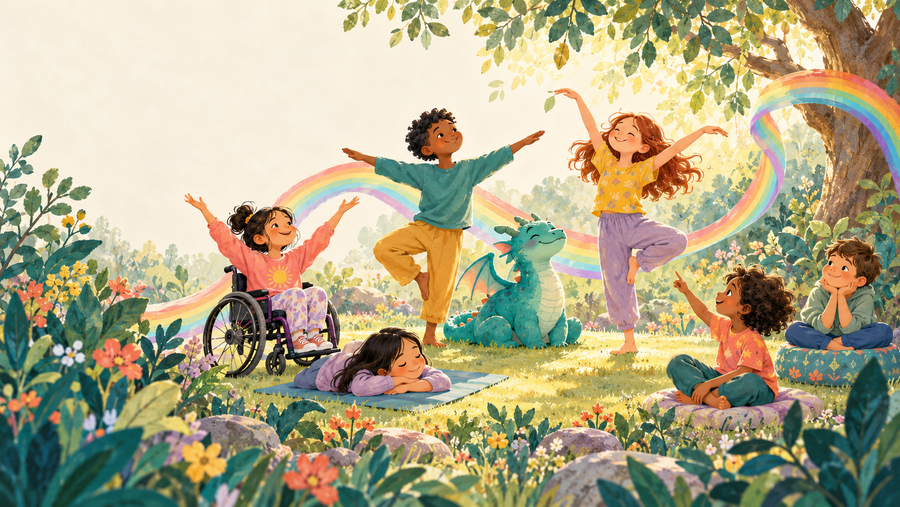
Opening scenes and the dragon adventure are illustrative teaching examples. Hero artwork: original AI-generated illustration created for this article.
Keep exploring
More from Kids Yoga Articles
Kids Yoga Articles
The Bedroom Generation: Children Need More Life, Not Just Less Screen Time
My teenagers spend much of their time in their bedrooms, too. What helps is finding their interests: strength, confidence, adventure and conne...
Read articleKids Yoga Articles
Why Your Favourite Stars Practise Yoga and Mindfulness
Footballers, pop stars, superheroes and a gaming legend also need a moment. Meet seven familiar faces who have spoken about yoga or meditation...
Read articleKids Yoga Articles
The Child Who Does Every Pose But Still Feels Outside the Circle
Why belonging matters in kids yoga, and how teachers can build connection through partner play, human mandalas and small acts that make room f...
Read article
Comments