
Rainbow Yoga articles
The Bedroom Generation: Children Need More Life, Not Just Less Screen Time
My teenagers spend much of their time in their bedrooms, too. What helps is finding their interests: strength, confidence, adventure and connection. A research-informed look at screen time, belonging and practical invitations for families and kids yoga teachers.
Children need more life, not just less screen time
I have teenagers. They spend much of their time in their bedrooms. And yes, I teach yoga, talk about connection and spend a considerable amount of my life encouraging people to move together.
Parenthood has not awarded me a special exemption.
Getting my teenagers out can take effort, thought and a surprising amount of creative programming. A walk on the beach. A hike in the mountains. Surfing. Going to the gym together. The question is not simply, “What do I think would be good for them?” It is, “What would make this interesting to them?”
Want to become stronger? Let’s go to the gym together. Want to feel confident in your body? Let’s learn something physical that feels exciting. Love the ocean? Let’s surf. Need time with a friend? Perhaps the invitation needs another person, not another parental speech.
The teenagers have not ordered a lecture on lifelong wellbeing. We should probably stop delivering one with every pair of shoes.
What I keep coming back to is this: connect with the wish beneath the behaviour. Strength. Confidence. Friendship. Independence. Adventure. Feeling capable. Then look for a real-world experience that speaks to that wish.
Not a trick. Not a covert rehabilitation programme disguised as a beach walk. An honest invitation into something we might enjoy together.
Because removing a screen does not automatically add a life.
Children do not merely need fewer reasons to stay in their bedrooms. They need more reasons to come out.
A generation behind a door, but not necessarily by choice
The Centre for Social Justice’s September 2026 report, Inactive Nation: Part Two, describes a “bedroom generation” in England. It reports that more than a third of 15-year-olds hardly ever leave their bedrooms except for school, nearly one in five spend no evenings out with friends, and almost a quarter spend at least six waking hours in their bedrooms on a normal weekend day. [1]
But the finding that should interrupt the adults’ chorus of despair is this: three in four want to spend more time doing activities outside their homes. [1]
This is a think-tank report drawing on survey evidence, not a clinical diagnosis or an experiment proving that phones caused withdrawal. Its figures concern a particular age group and setting. They do not describe every teenager everywhere.
Still, that gap between what young people do and what they say they want deserves attention.
Perhaps some of the question is not, “Why won’t they go out?” but, “What is getting in the way?”
And before we organise a nationwide bedroom evacuation, let us be clear: privacy, reading, gaming with friends, making music, resting and recovering from an overwhelming day are not moral failures. A bedroom can be a sanctuary. The aim is a life with choices, not a permanently occupied family lounge.
Less screen time is only half a plan
“Get off your phone” is an instruction about what to stop.
It contains remarkably little information about what to start.
Where can a young person go without spending money? Who will be there? Will they feel welcome? Can they get there? Are they allowed to be a beginner? Will someone make fun of their body? Will the activity be enjoyable, or has a caring adult simply repackaged another obligation as “fun”?
We should have boundaries around digital life. But subtraction alone is a rather meagre philosophy of childhood.
A world with fewer screens could still be lonely, rushed, inaccessible and spectacularly boring. Replacing scrolling with being corrected by adults for an extra hour is not an irresistible offer.
The better question is: what kind of offline life are we inviting children back into?

Start with their interest, not our lecture
There is useful research behind the idea that participation involves more than persuasion. A systematic review of 34 qualitative studies in physical education found that students’ experiences of competence, connection and autonomy mattered to participation. Teaching that undermined competence or allowed peer teasing could work against engagement. [2]
In everyday language: Do I get a say? Can I experience progress? Do I belong here?
These are helpful questions, not three buttons that reliably switch a teenager on. A separate 2023 review of nine out-of-school physical-activity interventions based on self-determination theory found no statistically significant pooled improvement in activity behaviour. A promising framework is not a guaranteed result. [3]
For parents and teachers, the practical implication is to get curious rather than become more forceful.
Ask, “What would you actually like to be able to do?” Then listen without immediately improving the answer.
If they want strength, start there. If they want to look good, do not sneer at the wish or turn it into a lesson about vanity. Acknowledge wanting confidence, then widen the conversation towards skill, enjoyment, energy and what their body can do. We can meet an interest without reinforcing the idea that a body must look different to deserve respect.
Surfing can offer adventure, learning and time together. A tan should not be the reward: UV tanning is skin damage, so keep the ocean and add sun protection. The beach has enough attractions without recruiting ultraviolet radiation as the family motivational coach. [10]
An interest-to-invitation guide
| What matters to them | An invitation to try |
|---|---|
| “I want to get stronger.” | “Let’s try the gym together and get qualified guidance. You choose a skill to work towards.” |
| “I want to feel more confident.” | “Would you rather try surfing, dancing or a balance challenge? Being a beginner is allowed.” |
| “I want to see my friends.” | “Let’s invite someone for a beach walk, a park game or a shared class.” |
| “I want more independence.” | “You help choose the route, timing and plan. We’ll agree on the safety boundaries together.” |
| “I’m exhausted by people.” | “Would a quiet walk, gentle stretch or sitting outside together feel better? We don’t have to talk.” |
These are invitations, not proven scripts. Make the offer real, affordable and small enough to try. For gym activities, prioritise age-appropriate coaching, technique and suitable supervision rather than maximum lifts or appearance targets. [11]
The essential word is often together. “You need exercise” gives someone an assignment. “Let’s go” offers company.
Bodies are not just transport for brains
The World Health Organization describes benefits of physical activity for children and adolescents that include physical fitness, bone health, muscle development, motor skills, cognitive outcomes and mental health. Movement includes walking, cycling, wheeling, active play and recreation, not only organised sport. [4]
That is a broader invitation than “Join a team or remain defective.”
A child can enjoy movement without wanting competition. A teenager can build a physical life without wanting a fitness identity. A family can begin with an ordinary walk rather than a complete personality renovation.
For kids yoga teachers, this is permission to offer more than calmness. Let children experience effort, balance, invention, manageable challenge and shared achievement, adapted to their bodies and support needs.
We do not have to sell every activity as a nervous-system intervention. Sometimes the honest description is: “We are going to try something interesting, and you might discover a new ability.”
That is already a worthwhile proposition.


The best yoga practice may be the one they choose themselves
A study published on 16 September 2026 involved 306 secondary students in Kirtipur, Nepal. One school received four weekly 45-minute yoga sessions; two comparison schools did not. In the intervention group, the proportion reporting an intention to practise rose from 22.5% to 70.6%. [5]
Encouraging, but not a lifelong habit captured in a percentage. The study was quasi-experimental, relied on self-report and measured short-term outcomes. Its increase in “ever practised” yoga should not be mistaken for proof of regular independent practice. Sustained participation and broader health benefits remain open questions. [5]
It gives teachers a useful question to investigate in our own classes: would they ever choose this without us?
Could a child remember it tomorrow? Teach it to a friend? Adapt it? Use it because they like it, rather than because an adult is watching?
At the end of a class, invite each child to choose one movement, game or resting practice they might like to keep. They can also choose none. Ask what would make it more appealing.
A practice that belongs to the child is a different proposition from homework wearing stretchy trousers.
Belonging is not an optional extra
An ESRI report published on 17 September 2026 used Growing Up in Ireland data to examine school absence between ages nine and thirteen and compare cohorts a decade apart. Higher absence was associated with factors including disability, financial strain, adverse family events, poorer teacher relationships and earlier bullying. Schools involving students more in decision-making tended to have lower absence rates. [6]
These are associations, not proof that offering choices cures absenteeism. They do, however, challenge explanations that locate every participation problem inside the child. [6]
For a yoga class, try a different question before asking a reluctant child to join in:
What does joining in actually feel like here?
Who gets left without a partner? Who is corrected most? Who never sees a version that works for their body? Whose idea becomes the group’s game? Who gets laughed with, and who gets laughed at?
Do not ask a child to leave the safety of their room for an environment that recreates the reasons they withdrew.
Arrange groups thoughtfully rather than allowing public popularity contests. Offer solo, parallel and cooperative options with equal warmth. Stop mockery. Let children influence something that genuinely changes the session.
Belonging should be visible in the organisation of the room, not just written on its welcome sign.

“Go outside” depends rather heavily on which outside
Research published on 11 September 2026 analysed survey responses from 35,178 parents of US children aged three to five. Outdoor play was associated with neighbourhood safety, childcare attendance and child health; screen time, urbanicity and several family and demographic factors were also associated with differences in outdoor play. Safety and socioeconomic conditions partly accounted for racial and ethnic disparities. [7]
This was cross-sectional research about preschool children. It cannot tell us why an individual teenager stays indoors or establish which factor caused which. Its relevant lesson is that opportunities are shaped by surroundings, not simply parental enthusiasm. [7]
A safe beach, nearby mountains, transport and a gym membership are wonderful possibilities. They are not universal starting equipment for childhood.
For another family, “outside” involves traffic, cost, inaccessible facilities or nowhere to sit without buying something. Our advice should not turn access into another test parents are failing.
Teachers can help by offering low-cost sessions, lending equipment, providing clear access information and bringing playful movement into existing community spaces. A hall, courtyard or accessible park may offer more than an ambitious programme families cannot reach.
The practical question is not only, “How do we motivate this child?” It is also, “Which obstacle can we remove?”
A quiet practice is not automatically an accessible practice
One of the most useful counterpoints comes from a small Australian yoga study. Published online in August and in the September 2026 issue of Research in Developmental Disabilities, it piloted a co-designed, six-week online yoga nidra programme with 13 autistic children aged eight to fourteen. [8]
Anxiety changes were not statistically significant, and heart-rate-variability findings moved in an unfavourable direction. This was feasibility research, not an established anxiety treatment. Interviews with three children and their mothers produced themes about difficulties with body awareness, the value of concrete instructions and the convenience of being at home online. [8]
In other words, the screen can sometimes be a bridge into participation, not the enemy of it.
Keep communication devices and disability supports available. Do not treat every online connection as inferior or demand that children earn belonging through eye contact, touch, stillness or cheerful group participation.
And make invitations understandable. Instead of “Sense the energy moving through you,” try “Press your palms gently together, then release. Notice anything different?” Offer a visual choice, a demonstration, movement or an external focus. “I don’t know” and “I’d rather not” are useful answers.
We are inviting experience, not examining children on their ability to report an invisible inner weather system.

Schools are changing the default. What comes next?
On 13 September 2026, NSW announced individual-device learning limits to begin as recommendations in Term 1, 2027 and become mandatory in 2028. They range from 15 minutes daily for Kindergarten to Year 2, through 30 and 45 minutes in later primary years, to proportions of subject time in secondary school. The policy retains digital literacy and includes exemptions and adjustments for disability, additional needs and personalised learning plans. [9]
A policy does not prove that its exact minutes are scientifically optimal. But it makes the replacement question immediate: what will learning look like when a screen is no longer the automatic starting point?
Please do not let the only answer be “a different way to sit still.”
Teachers and home educators can use movement to explore ideas: make geometric shapes with bodies and floor markers; build a story through movement; measure an accessible obstacle course; create a cooperative problem with several possible solutions. Keep the learning intention clear and check understanding afterwards.
These are teaching suggestions, not claims that these particular games have been validated by the studies above. The opportunity is to design learning in which movement, curiosity and other people have a meaningful role.
What kids yoga teachers can do tomorrow
The following tools are practical proposals, not a tested treatment package. Adapt them to age, space, access needs, supervision and the children in front of you.
1. Run an interest check before a wellbeing check
Ask, “What would make today worth coming to?” Offer pictures or simple options: strength, balance, adventure, rest, making something or being with others. Allow a private answer or a pass.
Choose one suggestion to use and name the change: “You asked for more balance challenges, so we’ve made room for one.” Listening becomes credible when it leaves evidence.
For teenagers, use ordinary language. Not every thirteen-year-old wants to announce their feelings while holding a cuddly woodland creature.
2. Build a menu, not a compulsory performance
Offer three accessible stations: a wall-supported balance, comfortable seated or standing reaching, and a cooperative floor-marker puzzle. Demonstrate variations together. Children may practise independently, work alongside someone, collaborate or watch first.
Keep everyone on a stable surface. No lifting or climbing on other children is needed. Explain the space boundaries and how to stop. Recheck consent whenever optional contact changes.
Choice is not the absence of teaching. It is teaching with more than one doorway.
3. Let children edit the game
Introduce a simple mirror-movement activity, with no touching required. Then ask children to change one element: speed, level, story, distance or who leads. A seated participant can lead everyone else.
Before taking over, ask, “Is my intervention making this safer or more interesting, or am I simply missing the sound of my own instructions?”
Adults can hold the safety boundary without occupying every square centimetre of the imagination.
4. Make success noticeable, not comparative
Invite children to choose a personal discovery: a steadier version, a clearer request for help, a comfortable pause, a new way to cooperate. Do not rank bodies, flexibility, stillness or bravery.
Try, “You changed the position and found something that worked,” rather than “You’re the best at this.” Ask what they noticed, not whether they beat yesterday’s record.
Progress can mean stopping before pain or saying no clearly. The child is not an unfinished product on a conveyor belt of improvements.
5. Leave room for friendship without requiring sociability
Build in a short, supervised stretch of less-directed time with safe props or a shared creative task. Children can contribute a shape, a sound, a drawing, a practical job or quiet observation.
Do not eliminate someone from the game just when they most need a way into it. Do not force pairings that distress a child. Help children find a workable way to participate, including space beside the group.
A class can offer community without turning extroversion into its entry requirement.
6. Send home an invitation, not another assignment
Offer a tiny optional experiment: teach someone a favourite movement, invent a seated balance together, or choose a short walk and notice three interesting things. No streak, proof, photograph or public score is required.
Ask next time, “Was there anything you actually wanted to try?” An honest “No” is useful design feedback.
If nobody wants to repeat the practice, perhaps the practice needs development. The children are not obliged to protect our lesson plan’s self-esteem.

A family experiment without a disciplinary soundtrack
For one week, try replacing one recurring argument with a specific invitation.
Start with a question: “What have you wanted to try?” Make two realistic offers connected to the answer. “A short gym visit together, or a beach walk with your friend?” Let them influence the timing. Say how long it will last. A promised short walk should not secretly become a mountain expedition with a character-building surprise.
Reduce the practical friction: suitable equipment, transport, a manageable first visit, appropriate instruction and a clear way to take a break. For outdoor plans, consider conditions and access. Keep surf activities within ability, with appropriate supervision and local safety guidance.
Then participate. Put your own phone away when it is not needed. Do not spend the activity explaining how much better this is than being on a phone. The outing does not need a director’s commentary.
Afterwards, ask, “What would make that better next time?” Not, “Admit that I was right.”
Some invitations will land. Some will not. You may find that their interest is different from the one you had assigned them. That is discovery, not defeat.
Nor must every experience be active. Shared cooking, music, making something or sitting outside can be part of a richer life. The goal is not to schedule away every private hour.
The door opens in both directions
None of this asks parents to become permanent entertainment departments. Teachers cannot solve unsafe neighbourhoods, unaffordable activities or absent support services with a more charming warm-up. Families need practical help, and communities need places where young people can belong without buying their way in.
Persistent withdrawal accompanied by distress, major changes in everyday functioning or safety concerns deserves a caring conversation and appropriate professional support. It is not a failure to be corrected through compulsory yoga or a sufficiently inspiring hike.
But we can begin somewhere real.
For me, that often means thinking harder about the invitation. A walk on the beach. A hike. Surfing. The gym together. Starting with what matters to my teenagers and finding an honest connection to movement, nature, challenge or time with another person.
Not, “Come out because your life is wrong.”
More, “There is something here you might enjoy, and I would love to share it with you.”
The bedroom generation does not need another generation standing outside the door delivering speeches.
It needs adults willing to help build a world worth opening the door for.
Keep exploring with Rainbow Yoga
For more practical teaching ideas, read The Child Who Does Every Pose But Still Feels Outside the Circle and Yoga Is Not Automatically Body-Positive.
Explore Rainbow Yoga teacher trainings for playful ways to bring movement, choice and connection into your teaching.
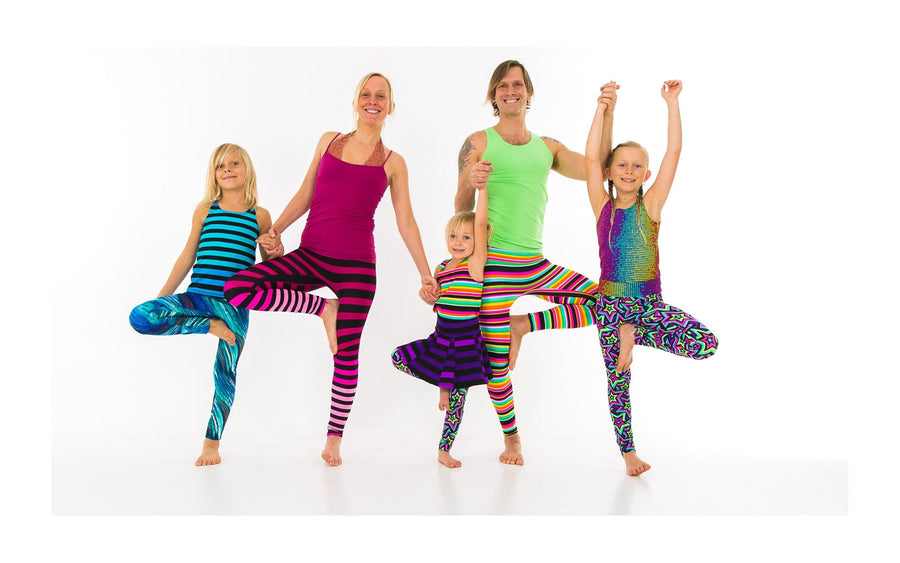
Photographs: Rainbow Yoga archive. These images illustrate shared practice and are not photographs of the research participants.
Research and further reading
The studies below cover different ages, countries and settings. They should not be treated as a single experiment or as evidence that yoga treats social withdrawal. Practical activities in this article are teaching proposals, not interventions tested by these papers. Sources checked 24 September 2026.
- Centre for Social Justice (September 2026). Inactive Nation: Part Two. Think-tank report and survey findings on adolescents in England. Read the report overview.
- White, R. L., et al. (2021). Self-determination theory in physical education: A systematic review of qualitative studies. Teaching and Teacher Education, 99, 103247. Review of 34 studies. University research record.
- Tapia-Serrano and colleagues (2023). Effects of out-of-school physical activity interventions based on self-determination theory in children and adolescents: A systematic review and meta-analysis. Scandinavian Journal of Medicine & Science in Sports, 33, 1929–1947. DOI: 10.1111/sms.14436.
- World Health Organization (26 June 2024). Physical activity. Evidence-informed public-health overview. WHO fact sheet.
- Panthi, S., et al. (16 September 2026). Effect of a School-Based Yoga Intervention on Behavioral Intention and Yoga Practice Among Secondary School Students: A Quasi-Experimental Study in Kirtipur, Kathmandu, Nepal. Health Science Reports, 9, e73263. PubMed; DOI: 10.1002/hsr2.73263.
- ESRI and Tusla Education Support Service (17 September 2026). Trajectories of school absence from 9 to 13 years of age and over time. Longitudinal and cohort-comparison research. Research findings.
- Rice, I., Lastrapes, M., Lee, E., & Anderson, A. R. (11 September 2026). Pathways to play: Race, neighborhood safety, and other correlates of outdoor play in early childhood. American Journal of Community Psychology. PubMed; DOI: 10.1002/ajcp.70106.
- Loftus, T., Yau, S. H., Soares, S., Byrne, J., & Mathersul, D. C. (online 22 August 2026; September issue). Co-designed yoga nidra targeting anxiety in autistic children: A mixed methods feasibility study. Research in Developmental Disabilities, 176, 105367. PubMed; DOI: 10.1016/j.ridd.2026.105367.
- NSW Department of Education (13 September 2026). Screentime limits in public schools to lift our game in the classroom. Policy announcement, including commencement dates and accessibility adjustments. Official announcement.
- Cancer Council Australia. Tanning. Public-health guidance on ultraviolet exposure and skin damage. Cancer Council guidance.
- American Academy of Pediatrics / HealthyChildren.org. Strength Training. Parent guidance on technique and supervision. Parent resource.
Keep exploring
More from Kids Yoga Articles
Kids Yoga Articles
Why Your Favourite Stars Practise Yoga and Mindfulness
Footballers, pop stars, superheroes and a gaming legend also need a moment. Meet seven familiar faces who have spoken about yoga or meditation...
Read articleKids Yoga Articles
The Child Who Does Every Pose But Still Feels Outside the Circle
Why belonging matters in kids yoga, and how teachers can build connection through partner play, human mandalas and small acts that make room f...
Read articleKids Yoga Articles
Before We Teach Children Positive Self-Talk, We Should Listen to How Adults Talk to Them
Children’s wellbeing needs an adult curriculum, too. Research, language swaps and practical tools for more thoughtful kids yoga teaching.
Read article
Comments