
Rainbow Yoga articles
Play, Feel, Experience - The Path to Learning and Growing
Explore play-based, social and embodied learning, with research and practical ways to build kids yoga classes around belonging, courage and meaningful experience.
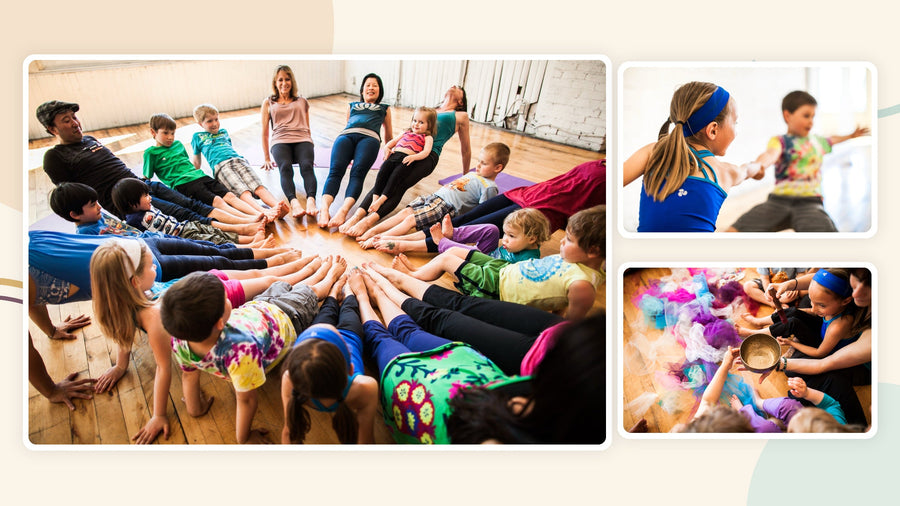
PLAY • CONNECTION • LEARNING THAT LIVES
What if a class could become a little piece of life: something real to try, someone real to listen to, a discovery children can feel—and take with them?
One of the sentences I hate most is: “Because I said so.”
Four little words. An entire educational philosophy wearing a very small hat.
A child asks why. An adult closes the door.
Sometimes we are tired. Sometimes we need everyone to put their shoes on before the sun retires. Sometimes there is an immediate safety boundary and no time for a discussion about the philosophical rights of a person holding a stick.
But as our everyday teaching method? We can do better.
Children spend much of their young lives being told what to do. Sit here. Stand there. Share. Be nice. Pay attention. Calm down. Hurry up. Be yourself—but preferably the version that fits into today’s schedule.
Then life happens. They try something. It goes beautifully, or spectacularly sideways. Someone listens. Someone lets them down. They discover what courage feels like, what cooperation makes possible, what a mistake can teach.
An instruction becomes something they understand from the inside.
What if we did not have to wait for life to teach the lesson later?
What if the learning was already an experience?
Children experience the adults around them
We tell children to listen while interrupting them. We tell them to use a quiet voice with a voice that could direct airport traffic. We ask for kindness, then make a child small in front of their friends.
They notice.
Children learn through words, of course. A story, an explanation or a thoughtful question can open a whole world. But words gain credibility through what happens around them. “Your opinion matters” becomes believable when their opinion actually changes something.
Our bodies, our tone, our timing and our response to a mistake are part of the curriculum. The lesson includes how it feels to be with us.
Classic research by Albert Bandura and colleagues showed that children could reproduce behaviours they had watched adults model. The original experiment concerned aggression, not yoga or kindness; its useful reminder is that observation itself can teach. Read the original study.
In my experience teaching children, I keep coming back to a simple principle: let your actions match your words. If I want children to practise respect, I need to respect their “no”. If I want them to ask for help, I can ask for help. If I want them to recover from mistakes, I can say, “I interrupted you. I’m going to listen now.”
There is a wonderfully practical lesson in watching a grown-up repair something without collapsing into a puddle of shame.
Social learning also happens between children: when they mirror a movement, negotiate a shared idea, wait for a turn or discover that someone else’s way works. We can build these encounters into the class.
One striking language experiment found that nine-month-old infants learned a particular Mandarin speech contrast after sessions with live speakers, while matched recordings did not produce the same effect. That finding belongs to a specific age and task, but it helps us appreciate responsive human interaction as part of learning. Kuhl and colleagues, 2003.

Play gives learning somewhere to happen
Play is often treated as the little sweet we hand out after children finish the nutritious business of learning.
But in play, children are already doing serious work. They test possibilities. Create rules. Change them. Discover what their bodies can do. Make a plan with another person. Meet frustration. Try again.
The American Academy of Pediatrics describes developmentally appropriate play as an important opportunity for learning and for building responsive relationships. Play can involve imagination, language, movement, social negotiation and self-regulation. Read its evidence report.
WHAT THE RESEARCH ADDS
Guidance and agency can work together
A 2022 systematic review examined 39 guided-play studies; 17, involving 3,893 children with study mean ages of 1–8 years, entered the meta-analysis. Guided play showed advantages over direct instruction for some early learning outcomes, including early maths and shape knowledge, and over free play for spatial vocabulary. Other outcomes showed no clear difference.
This gives us a promising combination: an adult holds a learning purpose, children have meaningful choices, and the adult responds with questions, prompts and support. It does not establish that every game is better than every explanation. Skene and colleagues, 2022.
In a kids yoga class, that might look like this: “Our animals need a way across the river. What can we create?”
You hold the boundaries: enough space, comfortable movement, nobody carrying another person’s weight. The children invent a route. Someone offers a seated riverboat. Someone becomes a bridge with their arms. Someone appoints themselves Head of Crocodile Relations.
There is a goal. There is a problem. There are ideas with consequences.
Children get to practise cooperation because cooperation changes what becomes possible. Their imagination has a job.
In my kids yoga classes, I build around four simple principles: FUN, TOGETHER, CO-CREATE, and start WHERE THEY ARE. Bring a plan, then meet the people in the room. Their energy, interests, needs and suggestions are information about how to bring that plan to life.
The body can participate in thinking
Try explaining balance to a child entirely through a definition. Now offer a comfortable tree shape, a hand on a wall and a chance to experiment.
“What changes when you widen your feet?”
“What helps you steady yourself?”
“Can your tree move with a little breeze?”
They have something to investigate.
Embodied learning brings movement, gesture and perception into the learning itself. In one experiment on mathematical equivalence, children who used meaningful, correct gestures learned more than those who used partly correct gestures or no gestures. What the gesture communicated mattered. Goldin-Meadow and colleagues, 2009.
So the question is not only “Are they moving?” It is “What does the movement help them discover?”
A shared movement can reveal the need to listen. Making a sequence together can reveal how different ideas fit. A wobble can become a chance to find support and begin again.
By somatic learning here, I mean learning through lived bodily experience: moving, sensing and noticing what happens from within. This is a practical description, rather than a claim that one particular body-awareness method has been proven to transform children.
In my kids yoga classes, we explore softness by moving like an uncooked noodle and then a cooked noodle. A very stiff spaghetti becomes an extremely unbusinesslike spaghetti. We can then ask what they noticed as they changed.
We do not need to provide the correct sensation. One child may notice effort. Another may laugh. Another may prefer the firmer shape. The discovery belongs to them.
Invite attention gently: “Notice your feet, your hands, your movement—or something you can see in the room.” Keep eyes open if preferred. Let a child pass. Bodily awareness should offer choice, and different bodies will give different information.

Start with what you want children to have the opportunity to FEEL
Before I choose the poses, the music or the story, I want to ask:
What do I want the children to FEEL?
Seen. Curious. Capable. Connected. Brave enough to try. Free enough to contribute. Comfortable enough to rest.
That is a powerful starting point for class building. Then we connect it to a learning purpose: What will children explore or practise through this feeling?
If the intention is belonging, a useful aim might be making room for another person’s idea. If the intention is courage, it might be choosing a manageable challenge and asking for support. If the intention is curiosity, it might be testing two possibilities and noticing the difference.
Emotion and thinking work together. Immordino-Yang and Damasio’s educational review describes the connections between emotion, decision-making and meaningful learning. Research on emotional memory also shows that emotional experiences can be especially vivid, while making some details more memorable than others. Strong feelings do not make every memory accurate. Emotion and learning. Emotion and memory.
So I use the familiar idea that people remember how we made them feel as a teaching compass. Children may forget the exact explanation. They may forget the order of the poses. The experience of “Someone listened to me”, “I could do it my way” or “I mattered here” can stay with them.
And the opposite experience can stay too.
A class about peace can feel humiliating. A lesson on kindness can feel controlling. A lesson on confidence can make a child afraid to get it wrong. The feeling is part of what we are teaching, whether we planned it or not.
A feeling is an invitation
We can create conditions for joy, belonging and courage. We cannot require a child to feel them. “Everybody must be happy now” is “because I said so” wearing a party hat.
A child can arrive tired, wary, sad or overstimulated. Let their response be real. The aim is an experience that meets them with care and opens a possibility—not an emotional performance for the teacher.
Transformation can be small, real and visible
I want children to be different at the end of a class because they have had a real, meaningful, transformational experience inside it.
That is an ambition worth designing for. It does not mean every child has to undergo a dramatic personal breakthrough between the welcome song and putting their socks back on.
A meaningful shift might be:
- “I was waiting for someone to choose me. Now I know my idea belongs.”
- “I thought I had to do it alone. Now I know I can ask for help.”
- “I got frustrated. We changed the plan. I tried again.”
- “I noticed I needed a rest, and that was allowed.”
- “We made something together that none of us had imagined alone.”
These are possible changes in understanding, participation and relationship. Lasting growth usually asks for repeated experiences, support and opportunities to use the discovery elsewhere. A smile at the door cannot prove that a child’s life has changed. A quiet child may have learned something we have not yet seen.
Research on social and emotional learning gives this work a wider context. A 2023 meta-analysis included 424 studies and 575,361 school students, finding improvements across several skills and relationship outcomes on average. Those were organised programmes, with outcomes shaped by context and implementation; the review did not test a single Rainbow Yoga class. Cipriano and colleagues, 2023.
My teaching conclusion is that social growth deserves opportunities to practise. We can build a small piece of life in which listening, generosity or perseverance makes a difference.
How to build a class that becomes an experience
Start with a feeling. Give it a meaningful experience. Help children notice what happened. Then give that discovery somewhere to go.
-
Choose a feeling and a learning purpose
Write one sentence: “I want children to have the opportunity to feel capable and supported.” Beside it, write the practice: “Try a challenge, ask for help, change the approach.” This keeps warmth and learning connected.
-
Give them something worth caring about
An imaginary animal needs a home. A garden needs everyone’s ideas. A sound has to travel around the circle. A dance needs another person’s contribution. Let there be a real task within the adventure, even when the world is imaginary.
-
Offer choices that change what happens
“Will you lead, join or watch first?” “Which route shall we try?” “How could we make this work while sitting?” In motivation research, autonomy, competence and relatedness offer useful questions about choice, capability and belonging. Structure and choice can support each other. Ryan and Deci, 2000.
When a child contributes an idea, use it. Co-creation becomes meaningful when the class actually changes.
-
Let the value do some work
To explore listening, create a task that gets easier when we listen. To explore generosity, give children something they can offer. In my kids yoga classes, a gloriously ordinary banana can travel around the circle as children contribute to a shared jungle soundscape. Later, a small gift is chosen with a particular person in mind. Giving and receiving become events to notice.
-
Add a challenge, then make another attempt possible
The first garden is lovely. Now a gentle wind arrives. Can the group adapt together? A little uncertainty creates something to investigate. Keep the challenge manageable; model slowing down, changing the plan and asking for help. Avoid manufacturing embarrassment or fear to make a lesson memorable.
-
Pause long enough to make meaning
“What helped?” “What changed when we used everyone’s idea?” “What would you try next time?” Let children talk, show, draw, gesture or pass. Reflection is part of experiential learning: experience becomes something we can understand and test again. A review of experiential-learning theory places reflection and further experimentation alongside doing. Morris, 2020.
Keep the questions open. “That made you feel good, didn’t it?” supplies an answer before the child has found their own.
-
Build a bridge into everyday life
Offer a tiny experiment: “Tomorrow, could you ask someone for help?” “Could you make room for one more idea?” Revisit it next class without a pass-or-fail ceremony. A discovery grows through another chance to use it.

TRY IT TOGETHER • ABOUT 12–15 MINUTES • ADAPT FOR AGES 6–10
Our Impossible Garden
Invite children to grow a garden with their movements, imagination and ideas. Let the experience say: “My ideas belong here, and we can build something together.” Along the way, they practise contributing, listening and adapting.
-
Plant an idea · 2 minutes
“We are growing a garden that has never existed before. What would you put in it?” Each child chooses a plant or creature and a comfortable movement. A seated sunflower, finger caterpillar or arm tree all work. Offer watching, a drawing or a spoken idea too. Add your own ridiculous plant: perhaps a carrot that sneezes confetti.
-
Make room · 3 minutes
Create groups of three with care, so no child depends on being picked by a friend. “Can your garden include something from each person?” Make a short sequence with all three ideas. Each contributor leads their part; others follow in their own way. A child who prefers to watch can help name the garden or suggest the order.
-
Meet the breeze · 3 minutes
“A gentle breeze is coming through our gardens. What might change?” Try the children’s suggestions. If the sequence falls apart, model curiosity: “We discovered something. Shall we slow down, make more space, or try a different order?” The group chooses and tries again.
-
Let the gardens visit · 2–3 minutes
Share a few gardens without ranking them. Invite appreciation tied to an action: “You slowed down so I could follow.” “You found a place for my caterpillar.” “You listened when I changed my mind.”
-
Notice and take one seed home · 2–4 minutes
Choose comfortable sitting, lying or staying as you are. Ask: “What changed when we used everyone’s ideas?” Offer a word, drawing, movement or silence. Then: “Where could you make room for someone’s idea tomorrow?” Children can choose a small experiment to try.
Keep space between bodies; nobody lifts, pushes or bears someone else’s weight. All touch is optional. No forced breath, breath-holding or closed eyes. Adjust movement, pace, sound and group size for the actual children. Shorten the activity when that fits them better.
The example is a teaching invitation, not a research-tested intervention. Look for participation, listening, changed plans and another attempt. Let children tell you what the experience meant.
Ask a better question at the end
“Did I get through my plan?” tells us something about the plan.
“What did the children experience?” opens the more interesting conversation.
Who contributed voluntarily? Who found an accessible way in? Who asked for help? Who changed their approach after listening? Who was still left waiting at the edge?
Notice those moments. Listen to the children’s answers. Change the next class accordingly.
We can explain kindness and create a moment in which kindness helps someone. We can describe courage and offer a challenge a child chooses to meet. We can talk about connection and build a circle in which people respond to one another.
There will be laughter. There will be wobbles. There may be an intense negotiation over whether a caterpillar is qualified to run a garden.
And there may be a child who leaves with one small, real discovery:
“I can.”
“I belong.”
“My idea matters.”
“We made this together.”
That is learning with somewhere to live.
LOVE, PEACE AND ROCK N’ROLL.
BRING THE EXPERIENCE INTO YOUR TEACHING
Build classes children can feel—and make their own.
Explore Rainbow Yoga training in playful movement, stories, connection and co-creation. Find the path that fits your experience and the children you want to teach.
Find my Rainbow Yoga training →Start today with the Impossible Garden. Let the children help you grow it.
Research notes & sources
Research checked 7 October 2026. This article brings together my experience in kids yoga classes, selected research and practical suggestions. It is not a systematic review. Evidence from infant-language experiments, early-years learning, school programmes and broader educational theory does not transfer automatically to every child or to the class example above.
- Skene et al. (2022), guided-play systematic review and meta-analysis. Thirty-nine studies reviewed; 17 meta-analysed, involving 3,893 children. Advantages for selected early learning outcomes, with no clear differences for others.
- Yogman et al. (2018), The Power of Play. American Academy of Pediatrics evidence report, reaffirmed January 2025; connects play, developmental opportunities and responsive relationships.
- Bandura, Ross & Ross (1961), observational learning. Original laboratory study of modelled aggression; the positive classroom examples here are teaching applications, not outcomes tested by that experiment.
- Kuhl, Tsao & Liu (2003), live social interaction and phonetic learning. Nine-month-old infants and one studied speech contrast; not a general verdict on recordings or learning at all ages.
- Goldin-Meadow, Cook & Mitchell (2009), gestures and mathematical learning. Task-relevant gesture experiment; it does not establish that any movement improves all learning.
- Immordino-Yang & Damasio (2007), emotion and education. Conceptual neuroscience review and educational implications, rather than a trial of this class-design method.
- Kensinger & Ford (2020), emotional memory. Emotion affects vividness and retrieval selectively; vividness does not guarantee accuracy.
- Morris (2020), experiential learning review. Reviews and proposes revisions to experiential-learning theory; reflection and further experimentation inform the practical sequence here.
- Ryan & Deci (2000), self-determination theory. Research review of autonomy, competence and relatedness; choice can coexist with clear guidance and boundaries.
- Cipriano et al. (2023), school social and emotional learning meta-analysis. Four hundred and twenty-four studies involving 575,361 students; varied programmes and implementation, rather than evidence for a single yoga class.
The opening scenes are illustrative. The Impossible Garden is a practical activity to try in your own class. Banner and photographs: Rainbow Yoga photo collection.
Keep exploring
More from Kids Yoga Articles
Kids Yoga Articles
Peaceful Teacher, Peaceful Class
Care for the teacher, care for the class: research on co-regulation, yoga for educators and practical 10–60 second resets for teachers and par...
Read articleKids Yoga Articles
But First, CONNECTION!
Why connection comes before content, correction and challenge—with research, coffee humour and practical ways to build belonging in kids yoga ...
Read articleKids Yoga Articles
The Best Practices Are The Ones Kids Keep Doing
Why choice, connection and meaningful play belong at the heart of kids yoga—with research, practical teaching ideas and a five-minute dragon a...
Read article
Comments