
Rainbow Yoga articles
Peaceful Teacher, Peaceful Class
Care for the teacher, care for the class: research on co-regulation, yoga for educators and practical 10–60 second resets for teachers and parents.
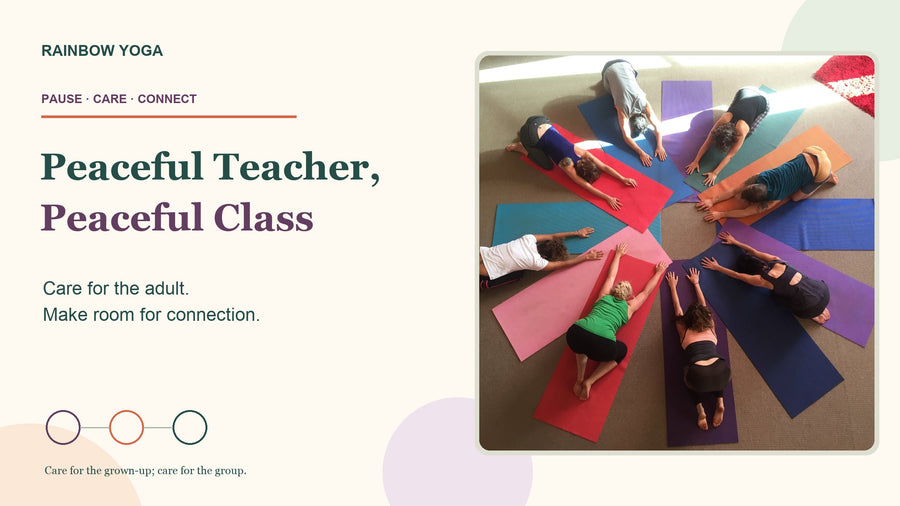
PAUSE. CARE. CONNECT.
The adult belongs in the care we are creating. Why our own practice matters—and small ways to find our feet before, during and after teaching.
Picture a kids yoga teacher arriving to teach peace.
The speaker will not connect. Someone needs the toilet. Someone else has very important dinosaur news. The class plan is beautiful. The teacher’s internal weather is approximately seven thunderstorms wearing a smile.
“Everybody, relax!”
There is a small possibility that the word everybody should include the person saying it.
We know the old rhyme, “Happy wife, happy life.” For the classroom, I would put this on the staffroom wall:
Care for the grown-up; care for the group.
Or, for the teacher who enjoys a little steam with their slogan: Refill the teacher. Refresh the room.
These are reminders about where care belongs. A teacher’s well-being matters in its own right. It also matters to the attention, tone, choices and help we bring into our relationships.
In my kids yoga classes, I want our practice to be felt in how we treat each other. That includes how the person leading the class treats themselves.
The teacher is a person before they are a programme
A kids yoga teacher can know thirty breathing games and still need lunch. We can have a brilliant relaxation script and a jaw quietly auditioning to become a nutcracker.
Knowledge helps. So do sleep, food, movement, rest, companionship, preparation and asking for support. Children deserve an adult with resources available for responding. The adult deserves those resources too.
Self-care is part of our responsibility as teachers. We can notice when we are rushing, carrying the previous interaction into the next one, or becoming sharper than the situation requires. We can practise a pause, use support, adjust the plan and repair a response that fell short.
That responsibility is active and practical: What do I need to notice? What can I change? Who can help?
It belongs alongside the responsibility of schools, studios and organisations to provide workable conditions. A teacher who needs a lunch break should not be handed a thirty-second meditation and a larger timetable.
UK Health and Safety Executive guidance identifies six areas of work design that matter for work-related stress: demands, control, support, relationships, role and change. Its useful insight travels well: look at the conditions around the person, as well as the person’s coping skills. Read the HSE framework.
For our work, that can mean preparation time, cover for breaks, usable procedures, responsive colleagues and a realistic conversation about group size or workload. Sometimes the most helpful yoga prop is another adult.
Here, peaceful means a way of responding with attention, care and clear boundaries. A Rainbow Yoga class can contain laughter, movement, noise and disagreement. A teacher can feel anger or stress and still choose a respectful next action. A child can remain upset while receiving excellent support.
The adult’s practice belongs in the educational picture
A new October 2026 study interviewed 11 teachers who had completed yoga training and used aspects of yoga in schools. They described stress management, professional agency, renewed purpose and more relational, collaborative ways of working. These were selected teachers’ accounts, rather than evidence that yoga caused improvements in children. They make a thoughtful case for taking the adult’s own experience seriously. Cross and Fisher, 2026.
That matters for kids yoga teachers. We are teaching from inside a relationship. Our practice can include how we arrive, how we listen and how we recover when the beautifully planned dragon adventure becomes an unexpected discussion about who touched whose sock.
PROMISING EVIDENCE. USEFUL LIMITS.
Some substantial teacher programmes have helped
The CARE for Teachers randomized trial involved 224 teachers in 36 elementary schools. Its thirty-hour programme, with coaching, improved several adult well-being and emotion-regulation measures, along with some observed interaction qualities, including positive climate and teacher sensitivity. Results varied across measures; instructional support did not improve. This was a substantial professional-development programme. Jennings and colleagues, 2017.
A follow-up of the same cohort, nine and a half months after the programme, found continued benefits in some self-reported measures, including psychological distress and emotion regulation. Other benefits did not persist across all measures. Continued care and practice deserve a place in the plan. Jennings and colleagues, 2019.
Two other randomized trials involving 113 teachers found improvements in reported stress and some burnout outcomes after an eight-week programme with thirty-six contact hours. Physiological stress measures did not show significant differences. Again, meaningful training is a different proposition from a single quick exercise. Roeser and colleagues, 2013.
The larger MYRIAD school trial gives us a useful counterweight. Its teacher analysis included 672 teachers in 84 schools. It found small burnout improvements after programme delivery, but these were no longer significant at one year. Most other adult measures showed little evidence of improvement. Helpful possibilities require careful expectations. Read the MYRIAD teacher study.
A 2018 meta-analysis of twenty-nine teacher studies described promising findings alongside heavy reliance on self-report and limited active comparisons. A newer 2026 synthesis of thirteen randomized trials also reported benefits while cautioning about substantial differences between studies. The lesson for us is to offer practices, observe how they serve the actual adults, and keep improving the support around them. Klingbeil and Renshaw, 2018; Yan and colleagues, 2026.
We can believe in the value of caring for teachers while remaining curious about what helps, for whom, and under which conditions.

Co-regulation: an adult helps make the next step possible
Co-regulation sounds like it needs a specialist cable. In practice, an adult offers responsive help with feelings, attention and actions.
A government research-to-practice brief describes three supports: a warm relationship, manageable environmental structure, and skills instruction or coaching. It also recognises that adults need practice, support and opportunities for breaks. This is a developmental framework, rather than a trial of a particular yoga activity. Rosanbalm and Murray’s co-regulation brief.
In a kids yoga class, those supports might look like this:
- Relationship: we notice the child’s wish and respond with care.
- Structure: the game has understandable rules, enough space and a clear way to take a turn.
- Coaching: we show how to ask, wait, choose another role or try again.
“I won’t let you pull someone’s scarf. You wanted that green one. Let’s ask for a turn.”
The child’s disappointment may continue. We have still stopped the grabbing, recognised the wish and offered help with the next action. That is useful teaching.
A study of 406 pupils in 17 classrooms found an association between teacher burnout and children’s morning cortisol. It was observational, with saliva collected on one school day. Direction and shared classroom conditions remained unresolved. It gives us a reason to care about the whole environment; it gives us no reason to blame an exhausted teacher for a child’s stress. Oberle and Schonert-Reichl, 2016.
We influence one another. We also bring different needs, histories and circumstances into the room. Care means keeping those differences in view.
A SMALL PRACTICE MENU FOR KIDS YOGA TEACHERS
Ten to sixty seconds to notice, choose or repair
These are short, practical invitations. The times are approximate spaces for practising, rather than deadlines for feeling calm. Research on breathing has tested longer, specific routines—for example, five minutes daily for a month—not these ten-second pauses. Balban and colleagues, 2023.
Keep your eyes open and appropriate supervision continuous while responsible for children. Use ordinary, comfortable breathing, without holds or forced deep breaths. If attention to breath feels unhelpful, notice your feet, a sound or something you can see. Attend to immediate safety first.
Before: let the teacher arrive too
1. Arrive where your feet are
Spend five seconds noticing the floor beneath you. Spend five looking at the actual room. Allow about five for an ordinary breath. Use the final five to choose your first warm sentence: “Hello, Maya. Would you like to wave or show me your hello movement?”
The aim is an available adult. We do not need an opening ceremony for our eyebrows.
2. Unclench before you instruct
For ten seconds, notice your hands, shoulders and jaw; soften what can soften comfortably. For ten, attend to ordinary breathing or a sound. For ten, choose one intention: “I will give one instruction at a time.”
A busy classroom already has plenty of things hanging in it. Your shoulders can retire from being coat hooks.
3. Give the plan two possible doors
Take twenty seconds to choose your first shared activity. Take twenty to prepare an easier or quieter version: seated clouds, smaller movements, or watching and suggesting the next weather change. Take twenty to prepare the transition and one clear boundary.
Preparation is a form of self-care. It reduces the number of decisions you need to invent while a small person explains the entire Jurassic period.
During: include yourself in the practice
4. Turn down the sentence
Notice the urge to say five things at once. Settle your feet for a moment. Let an ordinary exhale finish. Choose one concrete instruction: “Keep your scarf river near the floor.”
Speak clearly enough to be heard. If immediate harm needs stopping, give the protective instruction promptly.
5. See the child. Keep the limit.
Notice the specific action. State the boundary. Name the wish briefly. Offer a next step: “I won’t let you pull the scarf. You wanted that one. Come with me; we can ask for a turn.”
You can soften your jaw and keep the boundary. The boundary does not require your jaw’s assistance.
6. Let the transition include you
Invite seated or standing trees for ten seconds. Spend ten making a small sway together, each in their own space; join while keeping a clear view of the group. Use the final ten to announce the next scene and show its first movement.
The teacher gets to practise the transition too. Nobody needs perfect unison.
7. Repair a sharp moment
Once everyone is safe, own your part: “I spoke too sharply. Let me try that again.” Repeat the necessary limit without blame. Offer a workable choice and make returning to the activity straightforward.
A child does not owe you reassurance, a hug or immediate forgiveness. Show the repair through the next action. The minute starts the process; rebuilding trust can take longer.
After: do not carry every class into the next one
8. Give yourself an accurate debrief
Take ten seconds to name one useful thing you did. Take ten to name one hard moment. Take ten to choose an adjustment: fewer props, a clearer signal, a different opening, or earlier support.
“The transition needed more structure” gives you a next step. A dramatic review entitled “My Entire Teaching Career Is a Disaster” gives you very little to put on next week’s plan.
9. Make one real care request
Notice a need: water, food, the bathroom, planning time or a conversation. Choose a realistic action. Make the request specific: “Can you cover while I take a short break?” or “I need two minutes to reset the room before the next group.”
Complete a clear supervision handover before stepping away. When cover is unavailable, use an in-place pause and arrange support as soon as possible.
Adapt movement to your comfort and circumstances. Stop an exercise that feels unpleasant and choose another way to attend. These original suggestions have not been evaluated as a programme. They create opportunities to practise; longer-term care also needs time and support.

When we bring yoga into schools, include the teachers
We often arrive at a school with excellent things for children to do. I want us to bring something useful for the adults who will still be there after we roll up our mats.
Ask the teachers what the day is actually like. Where does the pace become difficult? What happens after lunch? When do they lose their preparation time? Which activities already work well?
Then offer a small, optional experience for the teacher as well as a class activity. Let adults try the practice, notice their own response and choose what fits. Seated, standing and observing versions can belong together. A staff session should be scheduled with the school so it supports the day, rather than becoming one more unpaid thing squeezed into somebody’s only break.
A one-minute staff practice: take twenty seconds to notice contact with the chair or floor; twenty for a comfortable arm reach and small shoulder movements; and twenty to return to ordinary breathing, look around and choose the next useful action. Adults can make smaller movements or simply observe. Offer this during agreed staff time, or after another adult has taken responsibility for supervision.
We can offer a minute before planning together, a short practice within professional development, or a supervised shared transition during a children’s class. Teachers need opportunities to experience the tools they are being asked to use.
Include the person who will carry the practice into tomorrow.
A useful school visit might leave behind three things: an experience the children enjoyed, a practice the teacher chose for themselves, and a clear agreement about where it can fit. Explain what the practice asks of the adult and what it does not promise about children.
10. Choose the next instruction
While children complete a familiar task you can supervise, spend five seconds checking your speed, five noticing the room, five choosing the next useful instruction and five saying it: “Put your books in this pile.” Let that action finish before adding the next direction.
Sometimes a centred teacher needs a shorter sentence. The children do not need a full guided meditation between a pencil and its destination.
Keep returning to the adult’s feedback. Did the practice help them notice, choose or recover? Was it convenient? Would they use it again? What would make it easier? An activity that adds pressure deserves an adjustment.
They are watching how we live
We can tell children “listen to your body,” then ignore our own need for rest. We can announce “mistakes help us learn,” then become furious when someone wobbles. We can ask for respectful voices while delivering the instruction in a voice that could peel paint.
The contradiction becomes part of the lesson.
Children learn from our explanations and from the behaviour surrounding those explanations. A developmental review of family emotional learning describes observation, adults’ specific responses and the wider emotional climate as connected influences. It offers a useful framework for thinking about our example in teaching; it does not establish that one calm adult automatically produces calm children. Morris and colleagues, 2007.
In my kids yoga classes, I want words and actions to agree. If I teach choice, I offer real choices. If I teach kindness, I include a child who needs another way to join. If I teach recovery after a mistake, I demonstrate recovery after my own.
“I am taking a moment so I can give you a clear answer.”
That is an adult practising a response. Children get to see that pausing is something a grown-up does too. We can name our action simply while keeping responsibility for our feelings with ourselves.
After a difficult moment, “My voice was too sharp. I’m sorry. I’ll explain it again” teaches something worth witnessing—especially when the explanation really does change.
We do not need to demonstrate perfection. We can demonstrate noticing, taking responsibility and making another attempt.

Parents, kitchens, homework—and beyond
The classroom principle travels home very easily. Often it arrives while somebody is objecting to a sock.
Parents also carry tiredness, unfinished work and more than one person’s needs. Caring for ourselves can help us decide how to begin the next interaction. Practical support matters here too: a handover, a simpler dinner, an honest request, a person we can talk with.
A review of twenty-five parent mindfulness studies suggested potential benefits for parenting stress. Many studies lacked strong comparison designs, and overall risk of bias was serious. It supports curiosity about adult practice while leaving firm claims about family outcomes unresolved. Burgdorf, Szabó and Abbott, 2019.
11. Choose the opening
Before responding to homework resistance or a family disagreement, notice your own pressure. Choose what needs addressing now. Begin with an observation and a manageable next step: “Starting is feeling hard. Let’s look at the first question together.”
Stay present to children who need supervision. Use the pause when stationary and able to attend.
12. Ask for something someone can answer
With the child appropriately cared for, name what is happening: “The afternoon has been intense, and I’m getting short.” Ask for specific support: “Could you take over snack while I have a short break?” Agree who is responsible for what.
When another adult is unavailable, choose an achievable simplification and arrange support when possible. A clear request also helps with colleagues, partners and friends.
Adult care extends beyond the mat. It includes how we finish work, what we expect of ourselves, the boundaries we keep and the help we allow ourselves to receive.
Small practices are easiest to find again when we attach them to an existing moment: before opening the classroom door, while collecting the scarves, before replying to a message, after the children leave. Choose one or two that fit your life and make room for them.
What would count as a useful difference?
Ask questions about the response you can influence:
- Did I notice my rush before adding five more instructions?
- Did I make the boundary clear while preserving care?
- Did I adjust the demand or help the child practise a next step?
- Did I repair my part when I got it wrong?
- Did I meet a real need or ask for support?
The child’s immediate mood is only one piece of information. Look at whether the interaction became clearer, more workable and more respectful. Keep listening to the people in the room.
Self-care can include thirty seconds with your feet on the floor. It can include going to bed. It can include asking for cover, getting appropriate help, changing an unreasonable plan or making time for a practice you enjoy.
We are part of the learning environment. We also deserve to be part of its care.
Care for the grown-up; care for the group.
Notice. Choose. Repair. Keep practising.
Bring the games. Bring the knowledge. Bring your wonderfully imperfect humanity.
And let the teacher have a turn at the yoga too.
LOVE, PEACE AND ROCK N’ROLL.
BRING YOUR OWN PRACTICE INTO YOUR TEACHING
Care for the adult. Create space for connection.
Explore Rainbow Yoga training in playful movement, shared experiences and responsive teaching. Find a pathway that fits your work with children—and bring curiosity about your own practice along.
Find my Rainbow Yoga training →Choose one tiny reset for your next class. Notice whether it helps you respond. Then keep learning together.
Research notes & sources
Research checked 7 October 2026. This article combines my teaching principles, selected research and original practical suggestions. It is not a systematic review. Teacher programmes, family studies and developmental guidance answer different questions; their findings cannot be treated as evidence for the exact 10–60 second routines here. The title expresses a teaching aspiration, rather than a guarantee of child outcomes.
- Cross & Fisher (2026): yoga and teachers’ professional identity. Qualitative accounts from eleven yoga-trained teachers; no causal or student-outcome test.
- Jennings et al. (2017): CARE for Teachers. Randomized trial, 224 teachers across 36 schools, thirty hours plus coaching; benefits varied by outcome.
- Jennings et al. (2019): CARE follow-up. The same cohort, with some adult benefits at nine and a half months; not an independent replication.
- Roeser et al. (2013): two teacher mindfulness trials. One hundred and thirteen teachers, eight weeks and thirty-six contact hours; self-report benefits without significant physiological effects.
- MYRIAD teacher trial (2022). Analysis of 672 teachers in 84 schools; small burnout improvements did not remain significant at one year.
- Klingbeil & Renshaw (2018): teacher mindfulness meta-analysis. Twenty-nine studies; design and measurement limitations reduced certainty.
- Yan et al. (2026): teacher work-stress meta-analysis. Thirteen randomized trials; substantial heterogeneity, with no headline effect size used here. Primary abstract verified.
- Rosanbalm & Murray (2017): co-regulation practice brief. Developmental research synthesis and guidance; relationships, environment and skills coaching.
- Oberle & Schonert-Reichl (2016): teacher burnout and pupil cortisol. Observational study, 406 pupils in 17 classrooms, one collection day; association is not causal blame.
- Balban et al. (2023): structured breathing practices. Five minutes daily over a month; not a test of these short ordinary-breath pauses.
- Morris et al. (2007): family context and emotion regulation. Review and developmental model; teaching applications are interpretations.
- Burgdorf, Szabó & Abbott (2019): parent mindfulness review. Twenty-five studies with serious overall risk of bias; firm causal family-outcome conclusions unavailable.
- UK Health and Safety Executive: work-stress Management Standards. Work-design guidance, not a trial of teacher yoga or jurisdiction-specific advice for every reader.
Class scenes and dialogue are illustrative. The short practices are original teaching suggestions. Banner and photographs: Rainbow Yoga photo collection.
Keep exploring
More from Kids Yoga Articles
Kids Yoga Articles
But First, CONNECTION!
Why connection comes before content, correction and challenge—with research, coffee humour and practical ways to build belonging in kids yoga ...
Read articleKids Yoga Articles
Play, Feel, Experience - The Path to Learning and Growing
Explore play-based, social and embodied learning, with research and practical ways to build kids yoga classes around belonging, courage and me...
Read articleKids Yoga Articles
The Best Practices Are The Ones Kids Keep Doing
Why choice, connection and meaningful play belong at the heart of kids yoga—with research, practical teaching ideas and a five-minute dragon a...
Read article
Comments