
Rainbow Yoga articles
Five Minutes of Family Yoga: Less Perfect Poses, More Connection
Try five minutes of family yoga with no equipment or perfect poses: simple, inclusive games for choice, shared movement and connection, plus teaching ideas.
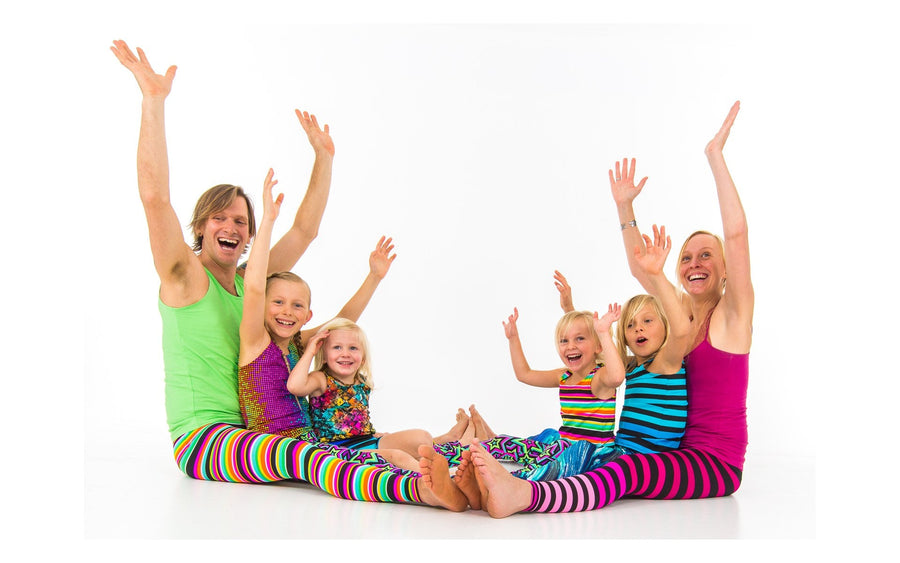
Simple family yoga games for children, teenagers and the adults who care for them. No equipment, perfect poses or compulsory hugs required.
There is a particular kind of family photograph in which everybody appears to have been assembled by a committee specialising in inner peace.
The child is balanced. The parent is radiant. The clothes match. Nobody needs a snack, dislikes the music or has just accused their sibling of breathing competitively.
Lovely photograph.
Not a useful entry requirement for family yoga.
Most families do not need another activity at which to look impressive. They need a few experiences in which nobody has to be impressive at all.
What if family yoga were less about teaching children yoga and more about helping families find each other again?
Not as an alternative to talking about difficult things. Not as a cure for distress. As an ordinary, physical way to say: I am here. Your ideas matter. We can enjoy something together.
The practices below take about five minutes altogether. That is a manageable invitation, not a scientifically established dose of connection. You can stop after one minute. You can repeat the favourite bit. You can discover that today is a terrible day for family yoga and try something else.
No streak will be lost. No spiritual administrator will contact you.
What the research supports, and what it does not
The American Academy of Pediatrics’ clinical report on play, reaffirmed in 2025, describes play as an opportunity to support development and relationships. It encourages shared, responsive play rather than expensive equipment or a constant stream of adult instruction. This is professional guidance drawing on research, not proof that our particular five-minute routine produces specific outcomes. [1]
There is also direct, but preliminary, family-yoga research. A 2026 pilot studied 27 parent–child pairs involving autistic children in a nine-week virtual programme. It combined live yoga sessions with parent learning. Some measures improved within the intervention group, including parenting self-efficacy, but post-programme differences between the intervention and comparison groups were not statistically significant. The design and small sample limit what we can conclude. [2]
That is not a reason to dismiss shared yoga. It is a reason not to advertise it as a proven treatment for autism, anxiety or family relationship difficulties.
And it is certainly not evidence that five minutes is equivalent to nine weeks.
A separate Australian randomised trial of the structured Tuning in to Kids parenting programme involved 216 parents of preschool children. It found improvements in aspects of emotional communication and reported child behaviour. That programme involved substantial teaching and practice; its findings do not transfer automatically to yoga. Its relevance is that what adults learn to do in a relationship matters, not only what we ask children to do. [3]
So let us keep the invitation honest: these are opportunities to practise attention, choice, movement and enjoyment together. Notice how they land in your actual family.
The research can inform the invitation. The child still gets to tell us whether they like it.

Connection is not something we administer to children
There is a difference between playing with a child and managing a child through a recreational format.
In one version, the adult has a plan, the child is expected to comply, and every movement becomes an opportunity for improvement.
“Straighten your leg.”
“Look at me.”
“Try properly.”
“Now tell me how relaxed you are.”
We have accidentally opened a small branch of the performance-management department.
In the other version, the adult brings a safe invitation and some curiosity. They offer a variation. They notice a hesitation. They let the child contribute something unexpected. They occasionally look ridiculous without asking the child to rescue their dignity.
The body is not the only thing being practised. We are also practising how to be together.
That does not mean children decide every family rule. Adults remain responsible for safety and care. It means that a shared activity should contain some actual sharing of influence.
Children’s rights to express views and to play are recognised in the UN Convention on the Rights of the Child. Listening is not a prize awarded only after good behaviour. [4]
First, remove the unnecessary obstacles
You do not need matching mats, exceptional flexibility, a large room or an available biological parent. A trusted caregiver, grandparent or other appropriate adult can join in. Family structures, bodies and capacities differ.
Use a stable, uncluttered space. Seated versions count. So does moving one hand, looking towards an object, directing someone else, or watching before deciding.
Keep breathing comfortable. There is no need for breath-holding, forceful breathing, stretching into pain, lifting a child, climbing on another person or making somebody close their eyes. Ask before optional touch and stop when either person asks or shows discomfort. Observe the child’s established communication and access needs rather than interpreting silence as agreement.
This is an invitation to a few simple activities, not personalised medical or therapeutic advice. Follow individual professional advice where a child or adult has relevant health or movement needs.
Most importantly, give the practice an exit door. “We can stop or change it” is much more credible when stopping or changing it is actually allowed.

A five-minute family connection practice
These are original teaching suggestions, not the intervention used in the pilot study. The minute marks are flexible. A child who finds a wonderful game during minute two does not need to be transferred out of it by the timetable police.
Minute one: Choose how to arrive
Sit or stand comfortably near each other. Ask: “How shall we say hello today?”
Offer a wave, a funny movement, words, a bow or simply being nearby. Each person chooses for themselves. No hug is required.
Then ask one small question: “Would you like more movement or more quiet?” Words, pointing or an agreed gesture all work. Where choosing feels difficult, demonstrate one brief option and invite a change.
What you are practising: noticing a preference and allowing it to influence the experience. Not extracting a report about someone’s emotional state.
For an exhausted parent: sit down. Your attention is welcome even when your energy is not auditioning for a sports drink advertisement.
Minute two: The mirror that listens
Face roughly towards each other, or sit side by side so watching is comfortable. One person makes slow, manageable movements with their hands, shoulders or upper body. The other mirrors what they can.
After a little while, swap leaders. A child can also lead by describing a movement or choosing from two pictures. Keep the range comfortable and do not insist on eye contact.
Try noticing which speed makes it easier to stay together. When the follower loses track, change the movement instead of announcing failure.
What you are practising: adjusting to another person, taking turns and discovering that leading includes making something possible for someone else.
For teenagers: let them choose the music or the movement style. The activity does not need a babyish name to qualify as play.
Minute three: Invent a creature together
One person chooses a real or imaginary creature. The other invents a comfortable movement for it. Then reverse the jobs.
A giraffe might reach from a chair. A sleepy dragon might gently turn its head. A sea creature might move only its fingers. Nobody needs to get on the floor.
Ask, “What would this creature do next?” and allow an answer you did not plan. Keep movements away from furniture, other people and painful ranges.
What you are practising: shared imagination and responding to someone else’s idea without immediately correcting it.
The creature’s anatomy does not need to survive peer review. This is not an ecology assessment. Save scientific accuracy for the occasions when that is the learning intention.
Minute four: Make something that belongs to both of you
Create a three-movement sequence. Each person contributes one movement, then choose the third together. Do it slowly once or twice, with everyone adapting it to their own body.
There is no touching requirement. A shared sequence can be a shoulder circle, a hand wave and a gentle reach. In a larger family, people can contribute a sound, a movement or the order.
Ask, “What could we change so this works for both of us?” Do not automatically assign the child the job of adapting to the adult.
What you are practising: collaboration with a concrete result. You have made a tiny thing together rather than simply completed someone else’s instructions.
Minute five: Finish without a test
Choose a comfortable position. Notice one ordinary thing together: a sound, a patch of colour, the feeling of feet on the floor. Breathing may stay exactly as it is.
Ask, “Was there a bit you would keep, change or skip?” Accept a gesture, a word or no answer. Then say something genuine about your experience: “I enjoyed your idea for the dragon,” or “Thanks for showing me a slower way.”
Avoid “You must feel calmer now.” The child may feel lively, bored, connected, unchanged or ready for lunch. They do not owe the activity a favourable review.
What you are practising: an ending that makes room for honest feedback.
The aim is not to produce a peaceful-looking family. It is to make it a little easier to be a real family together.
What about the teenager who would rather remain in their room?
As I wrote in The Bedroom Generation, my own teenagers spend a great deal of time in their bedrooms. Finding an invitation that interests them can take thought and effort.
Sometimes that invitation is a walk on the beach. Sometimes it is a hike, surfing or going to the gym together. The starting point is their interest, not my certainty about what they should enjoy.
The same principle applies to family yoga. A teenager interested in strength might prefer a few comfortable, appropriately coached movement challenges to an animal story. Someone tired of people might want a quiet stretch alongside you with no conversation. Someone who enjoys music might design the soundtrack and sequence.
Ask what would make it worth trying. Keep the first invitation small. Honour the agreed duration. Do not turn “five minutes” into a surprise seminar on the benefits of spending less time online.
And when they decline, do not convert the refusal into evidence that they do not love their family. Protect the relationship while looking for another way to connect.
Yoga is one doorway. We do not need to insist that every human enters through it.
A useful class plan for family-yoga teachers
Try a 20-minute workshop in which the adult has something to learn as well as the child.
First three minutes: explain choice, comfortable movement and how to stop. Present solo, side-by-side and shared options together. Ask each pair or group to choose how they would like to begin.
Next five minutes: practise the mirror game with repeated leader changes. Invite adults to notice when they are helping and when they are taking over. No public reporting about their child is needed.
Next five minutes: invite each family to design a three-movement creature journey. Give clear safety boundaries, then leave space for invention. Offer a simple starting example to anyone who wants more structure.
Next four minutes: let families choose movement, looking at an object together or comfortable rest. Make the quieter area supervised and accessible rather than a place for people who are “not joining properly”.
Final three minutes: ask what they would keep or change. Offer one optional idea to take home. Explain that trying nothing at home is not failure and photographs are not proof of participation.
For mixed-age groups, let older children design variations without turning them into unpaid childcare staff. Avoid assuming that every child has two parents, lives with the adult who brought them or wants family circumstances discussed publicly.
Above all, do not make the adult–child relationship the class’s public performance. A child who wants space should not become a teaching demonstration about attachment. A tired parent does not need a roomful of witnesses while their patience is assessed.
When it goes wrong, practise repair
There will be misunderstandings. Somebody will take over. Somebody will get cross. A playful dragon may become an unexpectedly accurate expression of adult irritation.
The opportunity is not to pretend that good families never struggle. It is to show what can happen next.
“I kept correcting you. That took the fun out of it. I’m sorry. Shall we change the game or stop?”
That is a suggested repair script, not a guaranteed solution. The important part is the changed behaviour that follows it. Do not demand instant forgiveness, a hug or reassurance that you are still a wonderful parent.
If the same activity repeatedly creates conflict, choose a different activity. Connection is not measured by loyalty to a particular game.
And some difficulties need more than a shared activity. Persistent distress, family violence or concerns about a child’s safety call for appropriate support and safeguarding action. Family yoga cannot make an unsafe relationship safe by asking the child to relax within it. [5]

The future of the world is also happening between dinner and bedtime
When we discuss preparing children for the future, we often talk about skills that sound impressive in a strategy document.
Innovation. Adaptability. Communication. Leadership.
Useful things.
But the future will also depend on whether people can notice when another person has had enough. Whether they can share influence. Whether they can change a plan without experiencing it as defeat. Whether they can enjoy one another without turning every encounter into a contest.
A five-minute activity will not solve a global crisis. It can be a small place to practise the habits we say we want the wider world to contain.
The interesting question is not, “How early can children perform an excellent pose?”
It is, “What do they experience about being human while we practise together?”
They might discover that their idea can change something. That an adult can apologise. That bodies are for living, not merely looking at. That another person can be company rather than an audience.
And we adults might discover that connection does not always need a grand event. Sometimes it needs a little attention and the willingness to stop directing everything.
There may still be laundry on the sofa.
Let it witness the occasion.
Three questions families often ask
Does family yoga have to involve partner poses or touching?
No. Mirroring, shared stories, parallel movement and choosing an activity together can all be done without contact. Present no-touch options as equally welcome, not as a lesser version.
Is five minutes enough to make a difference?
Five minutes is our proposed manageable starting point, not an evidence-based treatment dose. Look for a worthwhile shared experience rather than a promised change in mental health or behaviour. Longer is not automatically better.
What should I do if my child says no?
Respect the refusal, check whether a different format would help, and leave another opportunity open. Try a shared activity connected with their interests. Do not use withdrawal of affection or forced touch to obtain participation.
Keep the invitation open
Try one minute today. Keep the part that feels worthwhile. Change the part that does not.
Explore how to listen to children’s voices, use the free Rainbow Yoga Play Audit, or discover Rainbow Yoga teacher trainings.
Less perfect poses. More chances to find each other.
Photographs: Rainbow Yoga archive. These images illustrate shared practice and are not photographs of the research participants. Research checked 14 October 2026.
Research and further reading
- Yogman and colleagues. The Power of Play: A Pediatric Role in Enhancing Development in Young Children. Pediatrics, 2018; reaffirmed January 2025. Read the clinical report.
- Song, Shen, Pang, Dong and Bo. Virtual parent-mediated yoga for children with autism and their parents: A pilot study. Research in Autism, 2026, 132, 202801. University research record and publisher DOI.
- Tuning in to Kids research programme, including Havighurst and colleagues’ 2010 randomised trial. Research and publications.
- United Nations Convention on the Rights of the Child, Articles 12 and 31. UNICEF convention text.
- Australian Institute of Family Studies. Responding to children and young people’s disclosures of abuse.
Activities are practical proposals, not clinical treatment. Adapt to the child, family, access requirements and professional advice where relevant.
Keep exploring
More from Kids Yoga Articles
Kids Yoga Articles
Play, Connection and Kinder Teaching: Your Rainbow Yoga Reading Toolkit
Free kids yoga resources for teachers and families: a printable Play Audit, family activities, child voice, belonging and practical adult-lang...
Read articleKids Yoga Articles
What If Children Aren’t Disengaged From Learning, but From the Way We Teach It?
Rethink student disengagement through meaning, clarity, access, challenge and belonging, with practical teaching tools and a playful habitat l...
Read articleKids Yoga Articles
We Ask Children to Listen to Their Bodies. Are We Listening to Their Voices?
Practical ways to listen to children in yoga, school and family life: meaningful choices, consent, accessible feedback and decisions that genu...
Read article
Comments